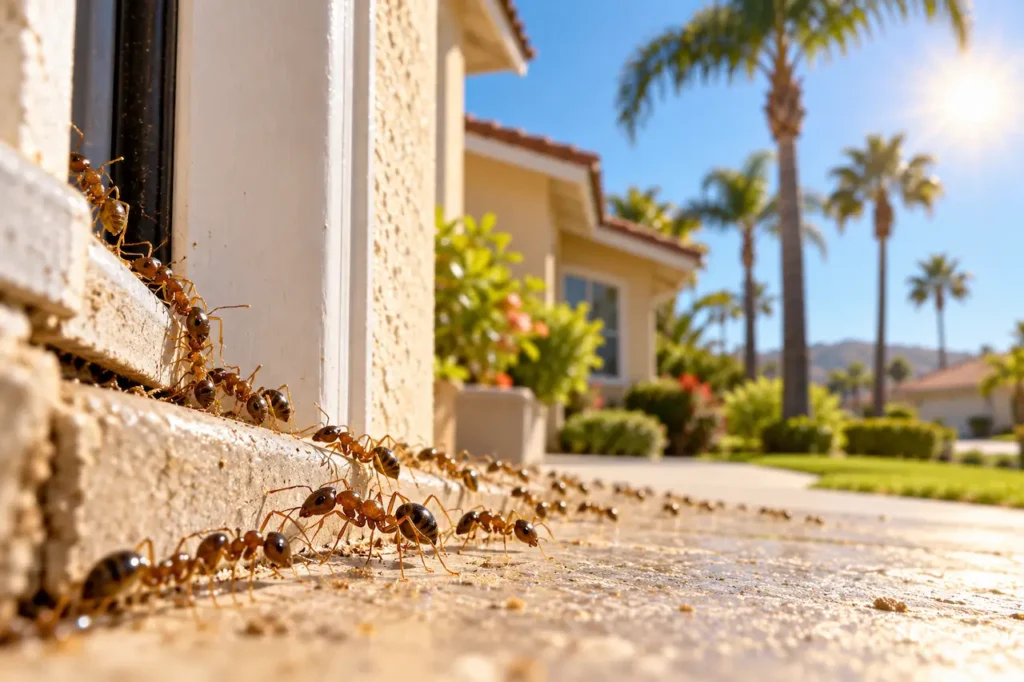
A few ants near the kitchen sink might not seem like a serious problem. But by the next morning, you could find dozens following the same route across your countertop, along the baseboards, or through a tiny gap beside the window.
For homeowners across Los Angeles County and Orange County, this is a familiar summer frustration. Argentine ants in California are especially persistent because they form interconnected colonies, travel in organized trails, and quickly take advantage of accessible food and moisture.
The problem often becomes more noticeable during Southern California’s hot, dry months, when ants search for reliable water sources. However, summer heat is only part of the explanation. Irrigated landscaping, outdoor colonies, kitchen spills, and unsealed entry points all contribute to recurring infestations.
Quick answer: Argentine ants frequently invade Southern California homes during summer because dry outdoor conditions, available indoor moisture, food sources, and nearby colonies encourage worker ants to forage inside. Effective prevention combines cleaning, leak repairs, exclusion, outdoor habitat management, and appropriate slow-acting ant bait when needed.
This guide explains why the invasions happen, how to identify the problem, which treatments are worth considering, and what you can do to prevent ants from returning.
Argentine Ants California: Why Are These Ants So Common?
Argentine ants (Linepithema humile) are an invasive species originally from South America. They are now widespread in California, particularly in urban and suburban landscapes where irrigation, ornamental plants, and mild weather provide favorable conditions.
Unlike many ant species that maintain separate, competing colonies, Argentine ants can form extensive networks of cooperating nests. These networks contain multiple queens and large numbers of workers.
This unusual colony structure helps explain why eliminating one visible trail rarely solves the entire problem.
The ants traveling across your countertop may belong to a colony network extending through garden beds, neighboring yards, sidewalk cracks, and other protected outdoor locations.
According to the University of California Statewide Integrated Pest Management Program, Argentine ants are among the most common household ant pests in California.
How Can You Identify Argentine Ants?
Argentine ants generally have several recognizable characteristics:
- Size: Workers are approximately 1/8 inch long.
- Color: Usually light to dark brown, with relatively uniform coloring.
- Movement: They commonly travel in distinct, busy trails.
- Food preferences: They frequently seek sugary foods and may also consume protein sources.
- Nesting behavior: Colonies often occupy soil, mulch, landscape materials, and protected outdoor spaces.
- Colony structure: Multiple queens and connected nests help populations persist.
Argentine ants do not sting, although they can occasionally bite. They are primarily nuisance pests rather than wood-destroying insects.
However, appearance alone cannot always confirm the species. Odorous house ants and other small household ants can look similar.
If identification is uncertain, photograph several workers and ask a qualified pest professional to examine them before selecting a treatment.
Why Does an Ant Invasion Happen During Summer?
Southern California’s climate creates conditions that can support Argentine ant populations throughout much of the year. However, seasonal changes in temperature, soil moisture, and available food can influence where workers forage.
1. Hot, Dry Weather Increases the Search for Water
Water is one of the biggest reasons Argentine ants enter homes during dry weather.
As outdoor conditions become less favorable, workers may investigate kitchens, bathrooms, laundry rooms, and other places where moisture remains accessible.
Common attractants include:
- Leaking faucets and supply lines
- Condensation around plumbing
- Damp areas beneath kitchen sinks
- Pet water bowls
- Moisture around dishwashers
- Wet sponges and standing water
- Leaks near outdoor faucets
Even a clean home can experience an infestation if ants can access a dependable moisture source.
What homeowners should do: Inspect plumbing connections, repair leaks, dry unnecessary standing water, and check areas where moisture collects overnight.
2. Outdoor Irrigation Supports Colonies Near Foundations
Regular landscape irrigation can make residential properties attractive to Argentine ants even during dry periods.
Moist soil beneath mulch, flower beds, potted plants, and ground cover may provide protected nesting and travel areas.
When these conditions exist directly beside a house, ants have a short route from outdoor colonies to windows, doors, foundation openings, and utility penetrations.
This creates a common problem: the homeowner treats ants indoors while the surrounding landscape continues supporting the colony.
What homeowners should do: Repair leaking irrigation equipment, avoid unnecessary watering against exterior walls, and keep dense vegetation and excess mulch away from the foundation where practical.
The goal is not to stop watering your landscape entirely. It is to eliminate unnecessary moisture and reduce pest-friendly conditions around the building.
3. Kitchens Provide Accessible Food
Argentine ants often forage for sweet substances, including syrups, fruit juice, sugar, and residues left on food containers.
Small amounts can attract workers.
A few drops of juice near a refrigerator or sticky residue beneath a trash container may be enough to encourage a trail.
Once workers discover food, they communicate through chemical trails that help additional ants follow the same route.
This is why a seemingly minor problem can become a noticeable invasion.
Homeowners dealing with repeated kitchen activity can follow our guide on how to get rid of ants in the kitchen fast for practical cleanup and prevention steps.
4. Large, Connected Colonies Make the Problem Persistent
Argentine ants are particularly difficult to manage because their colonies often contain multiple queens and interconnected nesting sites.
Removing the workers on your counter does not necessarily affect the reproductive ants living elsewhere.
Even when activity decreases around one part of the property, workers may continue arriving from another outdoor nesting area.
This means successful management should address the surrounding conditions and broader foraging activity rather than concentrating only on a single indoor trail.
5. Small Structural Gaps Provide Easy Entry
Argentine ants can exploit tiny openings around:
- Window frames
- Door thresholds
- Baseboards
- Plumbing penetrations
- Utility conduits
- Foundation joints
- Exterior siding transitions
These openings may be almost invisible without a close inspection.
An ant trail beside a kitchen cabinet may lead outdoors through a narrow opening behind plumbing rather than a nest located inside the cabinet itself.
Tracing the trail helps identify where exclusion measures will be most useful.
Why Do Argentine Ants Return After You Spray Them?
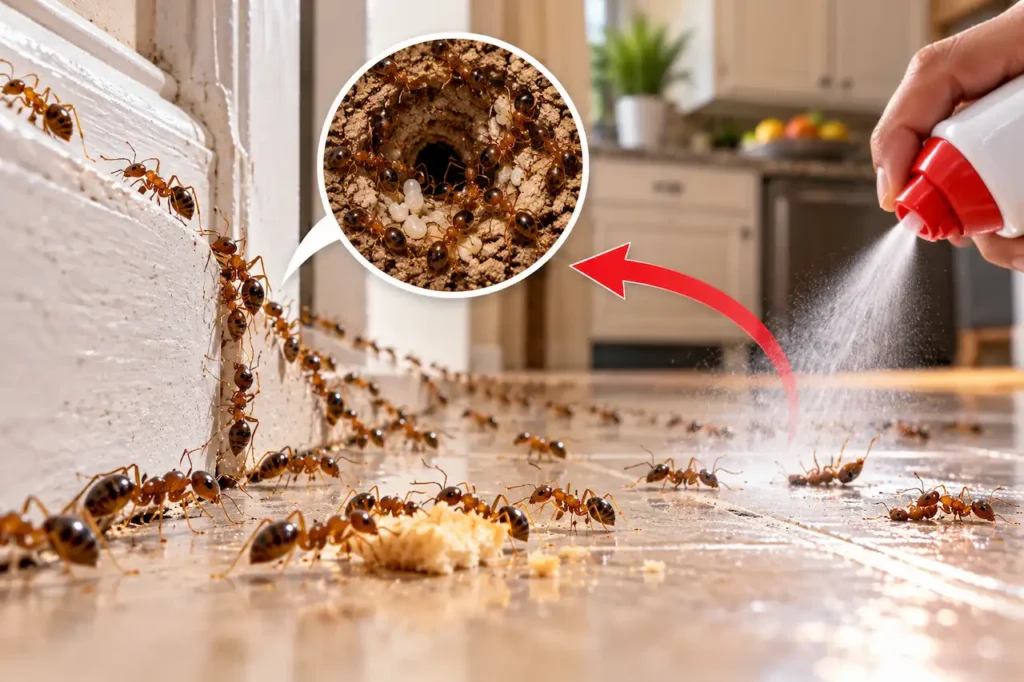
One of the most frustrating parts of summer ant control is watching a trail disappear after treatment, only to find another trail a few days later.
The reason is often simple: contact sprays generally kill exposed workers without eliminating the wider colony.
A large outdoor colony can continue sending workers along existing or alternative routes.
Broad spraying may also interfere with bait acceptance or redirect foraging into different areas.
However, not every return of ant activity means spraying created new colonies. Ants can reappear because untreated nesting sites, queens, food sources, and entry points remain.
Why Slow-Acting Baits Can Be More Effective
Ant baits combine an attractive food source with an insecticidal ingredient.
Foraging workers collect the bait and share it within the colony. Products designed to act slowly give workers time to return to nesting areas before the active ingredient takes effect.
Argentine ants commonly respond to sweet liquid baits, although preferences can vary with available food and seasonal conditions.
Baits are not an instant solution. Results depend on the species, product, placement, colony size, and competing food sources.
For an explanation of bait stations, gels, liquids, and other treatment methods, read our guide to ant control products for California homes.
Important: Always use products registered for the intended application, follow label instructions, and keep pesticides away from children, pets, and food-preparation areas.
Ant Invasion Summer Checklist: What to Do When Ants Enter Your Home
If ants suddenly appear, the most useful first step is to identify what is attracting them and where they are coming from.
Step 1: Locate the Active Trail
Before cleaning everything, observe where workers are moving.
Check whether the trail leads toward a window, doorway, pipe opening, wall gap, or outdoor planting area.
Take a photograph if possible.
Following the trail can reveal whether the problem is associated with a specific entry point or several connected routes.
Step 2: Remove Accessible Food
Clean crumbs, sticky spills, grease, and food residue from countertops and floors.
Pay attention to:
- Areas beneath appliances
- Trash and recycling containers
- Pet feeding stations
- Pantry shelves
- Kitchen cabinet corners
- Outdoor dining areas
Store food in tightly closed containers and avoid leaving pet food exposed for extended periods.
Step 3: Eliminate Unnecessary Moisture
Inspect the spaces beneath sinks and around appliances.
Fix leaking plumbing connections, empty standing water where appropriate, and investigate persistent dampness.
Outside, inspect irrigation lines and sprinkler heads.
Addressing moisture reduces one of the conditions supporting recurring summer activity.
Step 4: Clean Indoor Trails
A sponge or cloth with soapy water can remove visible ants and disrupt the chemical trails they use for navigation.
Cleaning helps restore the area, but it does not eliminate outdoor colonies.
If bait is being used, avoid cleaning directly over the active bait placement or spraying pesticides onto it.
Step 5: Consider Appropriate Ant Bait
For persistent trails, a properly selected bait may provide better colony-level control than repeated contact spraying.
Whenever possible, follow product directions for placing bait near outdoor trails or entry points.
Keep stations protected from children, pets, and environmental conditions that could damage or contaminate them.
If workers ignore the bait, the formulation may not match their current food preferences, or the station may be poorly positioned.
Avoid repeatedly switching products without understanding why a treatment is failing.
Step 6: Seal Entry Points
After identifying entry routes, repair gaps around windows, doors, utility lines, and plumbing.
Suitable caulking, weatherstripping, and building repairs can reduce access.
Sealing entrances supports long-term prevention, although ants may find alternative openings if surrounding colonies remain active.
Step 7: Monitor the Results
Check previously affected areas over the following days.
Record whether trails are decreasing, remaining stable, or appearing in additional rooms.
Slow-acting bait treatments may take several days to show improvement, and extensive infestations may need more time or professional follow-up.
If ants continue entering through multiple locations, arrange a property inspection rather than increasing pesticide applications without a plan.
Why Your Landscaping May Be Keeping Argentine Ants Nearby
Sometimes the most important ant attractant is not inside the home.
Argentine ants frequently collect honeydew, a sugary substance produced by plant-feeding insects such as aphids, soft scales, and mealybugs.
Ants can protect these insects from predators while feeding on the honeydew they produce.
As a result, plants supporting large numbers of aphids or scale insects may also attract substantial ant activity.
This relationship is especially relevant to properties with citrus trees, ornamental shrubs, and regularly irrigated gardens.
How to Reduce Outdoor Ant Activity
Inspect plants for sticky leaves, aphids, scale insects, and visible ant trails.
Where appropriate:
- Manage honeydew-producing plant pests.
- Prune branches touching exterior walls.
- Keep excess mulch away from foundations.
- Repair irrigation leaks.
- Remove fallen or rotting fruit.
- Reduce dense plant cover directly against the structure.
- Monitor trails around planters and patio edges.
These recommendations are consistent with UC IPM guidance on managing ants in gardens and landscapes.
Outdoor prevention is particularly important when ants disappear temporarily after indoor treatment but repeatedly return from the same garden or patio.
What About Argentine Ants in Apartments and Townhouses?
Shared housing can make ant prevention more complicated.
In apartments, condominiums, and attached townhouses, ants may travel through connected exterior landscaping, plumbing openings, wall gaps, and shared utility spaces.
A renter can keep an individual kitchen clean and still experience repeated trails if the colony is being supported elsewhere on the property.
This concern frequently appears in homeowner discussions, particularly where people report recurring ant activity despite cleaning and baiting.
Practical Steps for Renters and Property Managers
Renters should document recurring activity and report suspected leaks or structural entry points to property management.
Property managers should evaluate:
- Common landscaping and irrigation
- Shared trash areas
- Utility penetrations
- Recurring complaints across neighboring units
- Food and water sources in common spaces
A coordinated inspection may be more useful than applying unrelated treatments in individual units.
The same principle applies to commercial properties with shared kitchens, break rooms, and outdoor landscaping.
Are Argentine Ant Treatments Safe Around Children and Pets?
Treatment safety depends on the pesticide, application method, placement, and exposure conditions.
No pesticide should be assumed to be harmless simply because the package describes it as natural, environmentally friendly, or suitable for residential use.
Properly used enclosed bait stations can help limit access to bait, but they must still be positioned according to the product label.
For homes with young children, dogs, cats, or other animals, ask a pest professional:
- Which products will be used?
- Where will they be placed?
- Will pets need to be moved from the application area?
- Are there any re-entry requirements?
- How should damaged or disturbed bait stations be handled?
Avoid applying products to food-preparation surfaces or locations accessible to curious pets unless the specific label permits the use and all required precautions can be met.
For more detailed precautions, see our article on pet-safe ant extermination and treatment considerations.
When Should You Call a Professional for Summer Ant Control?
Not every ant sighting requires an exterminator.
A limited trail may respond to cleaning, leak repairs, exclusion, and correctly used bait.
Professional help becomes more valuable when:
- Ants return repeatedly despite prevention.
- Multiple rooms have active trails.
- The infestation involves several outdoor nesting areas.
- Ant activity continues after a properly implemented baiting period.
- Children or pets make treatment placement difficult.
- The species cannot be identified confidently.
- Shared landscaping or multiple units contribute to the problem.
A professional inspection can identify likely colony locations, foraging routes, moisture sources, and entry points.
For these situations, professional ant control services can help homeowners choose targeted treatment and prevention strategies suited to the property.
The right approach should be based on inspection findings, not an automatic schedule of repeated indoor spraying.
How to Prevent Another Argentine Ant Invasion Next Summer
Preventing future infestations is usually easier when homeowners begin monitoring before heavy summer activity develops.
Spring: Address Conditions Before Peak Activity
Inspect windows, doors, plumbing, irrigation equipment, and landscaping.
Seal identified openings and correct leaks.
Check plants for honeydew-producing insects.
Early Summer: Monitor Food and Water Sources
Increase attention to kitchen cleanliness and moisture control as outdoor conditions become hotter and drier.
Look for new trails near sinks, patio doors, and utility openings.
Mid-Summer: Respond to Recurring Activity
If ants return, identify the source before treating.
Appropriate baiting, exclusion, and property maintenance can reduce the pressure from established colonies.
Late Summer and Fall: Review the Results
Continue monitoring previous entry points.
Inspect outdoor areas after changes in weather and irrigation conditions.
Ants can also enter homes after heavy rain or other disturbances, so prevention should not stop automatically when summer ends.
For homeowners considering regular monitoring, our monthly exterminator service review explains when recurring pest management may be worthwhile and when a one-time service could be sufficient.
Argentine Ant Problems in Los Angeles County and Orange County
Argentine ants can affect single-family homes, apartments, restaurants, and commercial properties throughout Southern California.
Properties in Long Beach, Bellflower, Cerritos, Torrance, Downey, Carson, Anaheim, Buena Park, and other nearby communities may experience recurring activity associated with irrigated landscaping, outdoor food sources, and small structural openings.
The exact conditions vary by property. A home with a shaded, heavily irrigated garden may face different ant pressures from an apartment with shared walls and limited outdoor space.
Homeowners seeking pest control in Long Beach can explore local service information, while properties across Orange County may require different inspection and treatment considerations.
The most effective plan begins by understanding the actual conditions at the property rather than assuming every summer infestation has the same cause.
Frequently Asked Questions About Argentine Ants in California
Why are Argentine ants worse during summer in Southern California?
Hot, dry weather can encourage ants to search for accessible moisture, while food sources, irrigated landscaping, and established colonies support activity around homes. Summer populations may also be relatively high, although invasions can occur during other seasons.
Why do Argentine ants keep coming back after treatment?
Visible workers represent only part of the colony. Outdoor nests, multiple queens, alternative trails, and continued access to food or water can allow activity to resume. Effective management addresses colony pressure and conditions around the property.
How long does ant bait take to work on Argentine ants?
Some homeowners notice fewer ants after several days, but larger colonies may take weeks or require reassessment. Results depend on bait acceptance, formulation, placement, and the extent of the infestation.
Can Argentine ants damage a house?
Argentine ants are not considered wood-destroying pests like termites. Their main impact is recurring indoor contamination concerns and nuisance activity, although they can also support honeydew-producing pests on landscape plants.
Do Argentine ants bite humans?
They can occasionally bite, but they do not sting and are not generally aggressive toward people. Most household complaints concern persistent trails and large numbers of ants rather than bites.
Why are ants appearing in my bathroom when there is no food?
Bathrooms provide moisture from sinks, showers, plumbing leaks, and condensation. Ants may enter these areas while searching for water, even when no obvious food source is available.
Can Argentine ants enter an extremely clean house?
Yes. Cleanliness reduces available food, but ants may still enter through structural gaps to seek moisture or explore new foraging routes. A clean home can experience an infestation if nearby colonies and entry conditions remain.
Why do ants swarm around my pet’s water bowl?
A pet bowl provides accessible water, especially during hot weather. Keep feeding areas clean, address unnecessary standing water, and use prevention methods that do not expose pets to pesticides.
Does vinegar permanently eliminate Argentine ants?
No. Vinegar or soapy water may temporarily disrupt an ant trail, but neither reliably eliminates an established outdoor colony. Cleaning should be combined with exclusion, habitat management, and appropriate colony-level treatment when needed.
Are Argentine ants attracted to citrus trees?
They can be attracted to honeydew-producing insects that feed on citrus and other plants. Fallen or damaged fruit may also provide food. Managing plant pests and removing fallen fruit can help reduce attractants.
Will Argentine ants disappear when summer ends?
Activity may decrease when environmental conditions change, but established colonies can persist. Ants may return during future warm periods or after rain, especially when nesting areas, food sources, and entry points remain available.
Is professional ant control necessary every month?
Not necessarily. The appropriate service frequency depends on infestation severity, property conditions, previous activity, and treatment results. Some properties benefit from targeted one-time treatment and prevention, while others may need ongoing monitoring.
What should I do if ant bait seems to attract more ants?
Recruitment to an attractive bait can temporarily increase the number of visible workers. Avoid spraying the active bait area, keep children and pets away, and follow the product instructions. If activity does not begin to improve within the expected treatment period, reassess the bait and contact a qualified professional.
Can my neighbor’s Argentine ant problem affect my home?
Yes. Connected outdoor colony networks and shared landscaping can allow workers to forage across property boundaries. Managing your home’s entry points and attractants is still useful, but persistent problems may benefit from coordinated property management.
Stop Summer Ant Invasions Before They Become a Recurring Problem
A summer ant invasion is rarely just about the insects moving across your countertop.
The underlying problem may involve outdoor colonies, landscape irrigation, nearby honeydew-producing insects, hidden entry points, or accessible moisture inside the home.
The most reliable response combines proper identification, sanitation, moisture control, exclusion, appropriate baiting, and follow-up when necessary.
Impressive Exterminating Pest Control provides pest management services for residential and commercial properties throughout Los Angeles County and Orange County.
If Argentine ants continue returning to your kitchen, bathroom, patio, or other areas of your property, a professional inspection can help identify the source and determine which treatment and prevention steps are appropriate.