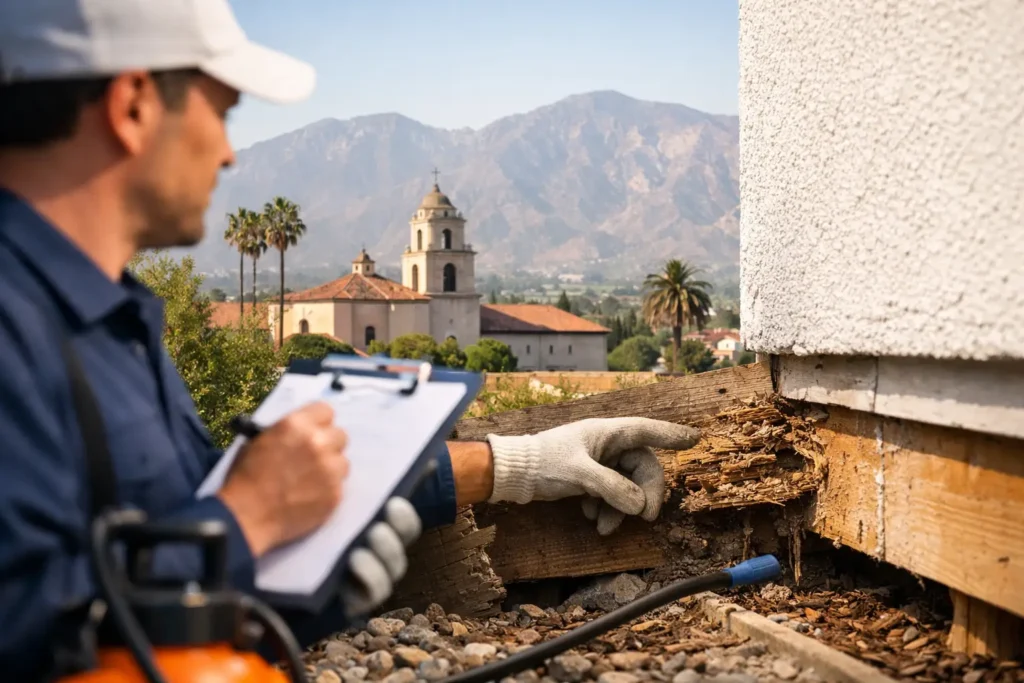
Termite damage almost always starts somewhere you’re not looking — inside a wall void, under flooring, along attic framing that still looks solid from the outside. By the time it’s visible, the colony has usually been active for a while. That’s why choosing the right termite company near Alhambra matters as much as how fast they can show up: a fast inspection is only useful if it comes with a treatment plan that actually fits your property.
What a Local Termite Company Near Alhambra Should Actually Help With
A good termite provider does more than confirm termites exist. They should explain how active the infestation appears to be, what conditions are letting it spread, and which treatment approach genuinely fits your home or building — not just the option that’s easiest to sell.
Alhambra-area homes commonly deal with drywood termites, subterranean termites, or both. They behave very differently:
- Drywood termites settle directly inside wood members and can stay hidden for long periods without needing soil contact — meaning they can turn up in roof framing, furniture, or upper-floor wood far from ground level.
- Subterranean termites generally need moisture and soil contact, entering structures from the ground and moving upward into framing.
A provider with real local experience in Alhambra and the surrounding San Gabriel Valley — older homes, mixed-use buildings, dense multifamily housing — will typically have a better read on common entry points and construction quirks specific to the area than a national call-center operation quoting sight-unseen.
Also Check: How to Choose an Exterminator You Can Trust
What Termite Treatment Actually Costs in the Alhambra / LA County Area
Termite pricing depends heavily on species, extent of activity, and treatment method. Current cost benchmarks for Southern California properties:
| Service | Typical cost range |
|---|---|
| Standard termite inspection | $75–$200 (often free with treatment) |
| Localized/spot treatment | $200–$800 |
| Liquid soil treatment (subterranean) | $3–$16 per linear foot of foundation |
| Full structural fumigation (drywood) | $1,500–$2,800+ for a typical 1,500–2,000 sq ft home; larger or more severe cases can run higher |
| Annual monitoring/renewal | $100–$300/year |
These are useful benchmarks, not a substitute for an actual inspection — the honest answer to “how much will this cost” always depends on what a technician finds on-site.
Not Every Termite Treatment Is the Same
One of the most common mistakes property owners make is assuming termite treatment is one uniform service. It isn’t. The right plan depends on species, how widespread the activity is, construction type, and how much disruption is realistic for your household or business.
Localized treatment works well when activity is contained and caught early — often less disruptive and more cost-effective, but only as good as the accuracy of the inspection behind it.
Soil treatment is the standard approach for subterranean termites, creating a treated barrier around the structure to stop new entry from the ground.
Fumigation (tenting) is typically reserved for widespread or severe drywood termite activity. It’s the most complete option for hidden infestations spread through a structure, but it requires temporary vacancy and advance planning — which is exactly why a trustworthy company won’t recommend it by default.
Questions to Ask Before Hiring a Termite Company
Focus less on the sales pitch and more on process:
- Is the inspection thorough enough to distinguish active infestation from old, already-treated damage?
- What treatment options are available, and are there less invasive alternatives when appropriate?
- How is follow-up handled? Termite control isn’t a single-visit event.
- For rentals or commercial buildings — can they coordinate around tenants and minimize disruption?
- Will they give you written findings and a clear scope of treatment, not just a verbal estimate?
Also Check: Best Ant Control Products for California Homes
Why Prevention Should Be Part of the Conversation
Treating an active infestation is only half the job. If the underlying conditions — moisture near the foundation, wood-to-soil contact, gaps around utility lines, damaged wood — stay in place, the risk of a repeat infestation stays with them. This matters most for owners who’ve already paid for one round of treatment; a company thinking beyond the immediate problem is the one protecting your long-term investment, not just closing a job ticket.
What Local Service Actually Changes
Working with a termite company based near Alhambra typically means faster scheduling and a more practical understanding of how termite problems show up in local housing stock — older construction, additions with hidden voids, multifamily buildings where one unit’s activity can affect neighboring units. That local familiarity often shows up as fewer surprises during inspection and treatment, not just a shorter drive time.
If you suspect termite activity — discarded wings near a window, small pellet-like droppings, a door that suddenly sticks — the smartest next step isn’t waiting for more evidence. Impressive Exterminating provides licensed, inspection-driven termite service to Alhambra and the surrounding San Gabriel Valley. Call (562) 246-9044 for a free inspection.
Frequently Asked Questions
How much does a termite inspection cost near Alhambra, CA?
A standard termite inspection typically runs $75–$200, and many local companies — including Impressive Exterminating — offer it free when paired with treatment. If you need a formal report for a real estate transaction (a termite clearance letter for a lender), that documented inspection may cost more due to the added paperwork.
Is fumigation always necessary for drywood termites?
No. Fumigation is generally reserved for widespread or hard-to-access drywood infestations. If activity is contained to a limited, accessible area, localized (spot) treatment may resolve the problem at a fraction of the cost and disruption. An accurate inspection — not the treatment budget — should determine which approach fits.
How do I know if I have drywood or subterranean termites?
Drywood termites leave dry, pellet-like droppings (frass) that resemble coffee grounds or sand near infested wood, and they don’t require soil contact — so activity can appear well above ground level. Subterranean termites build mud tubes along foundations and framing to travel between soil and wood, since they need consistent moisture. A professional inspection can confirm which (or both) is present, since treatment differs significantly by species.
Can I sell my house in Alhambra with an active termite infestation?
It’s possible, but most California real estate transactions require a Wood Destroying Organism (WDO) inspection, and lenders — especially for FHA and VA loans — often require a termite clearance letter before closing. Addressing termite activity before listing typically avoids delays or renegotiation during escrow.
How long does termite treatment take to complete?
Localized and soil treatments are often completed in a single day. Full fumigation typically requires the structure to be vacated for one to three days, including tenting setup, gas exposure, and clearance aeration time, plus advance scheduling.
Do termite treatments come with a warranty or guarantee?
Many licensed termite companies offer a warranty period — commonly one to several years — during which they’ll re-treat at no additional cost if termites return. Always get the specific terms in writing before signing, including what triggers a free re-treat versus a new charge.
How often should I get my Alhambra home inspected for termites if I’ve never had an infestation?
Annual inspections are a reasonable baseline for most Southern California homes, given the region’s consistent termite pressure. Homes with older construction, extensive exposed wood, mature landscaping against the structure, or known moisture issues may benefit from more frequent monitoring.