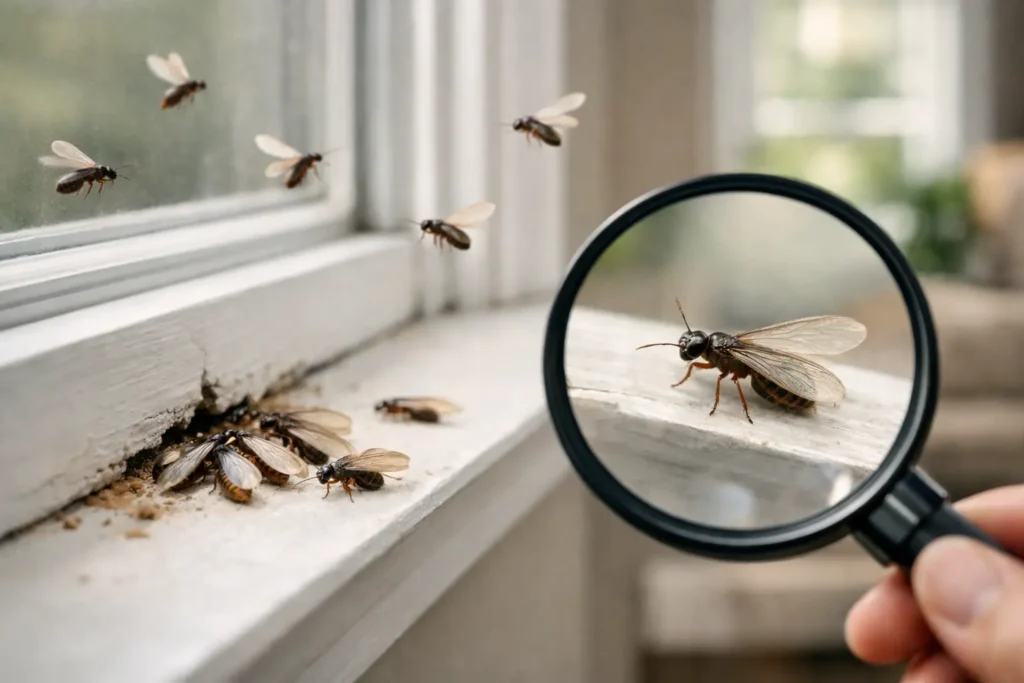
Quick answer: A termite swarmer has a thick, straight waist, straight bead-like antennae, and two pairs of wings of equal length. A flying ant has a narrow, pinched waist, bent (“elbowed”) antennae, and front wings clearly longer than its back wings. If you find several winged insects indoors, or a pile of shed wings on a windowsill, schedule a professional inspection rather than guessing.
A small cluster of winged insects near a window can be easy to dismiss, especially after warm weather or rain. But knowing how to identify termite swarmers can help you act before hidden termite activity becomes costly damage. Swarmers do not always mean termites are actively eating the wood in that exact room, but they do signal that a mature colony may be nearby and deserves professional attention.
For homeowners, landlords, and business owners in Los Angeles County and Orange County, a fast inspection is the most reliable way to get answers. In the meantime, a few visible details can help you tell termite swarmers apart from flying ants and decide what to do next.
How to Identify Termite Swarmers by Their Appearance
Termite swarmers are the winged reproductive members of a termite colony. When conditions are right, they leave an established colony to pair up and start new colonies. You may see them flying around lights, gathering at windows, or crawling on floors after they have dropped their wings.
The clearest way to identify them is to look at their body shape, antennae, and wings. A termite swarmer has a broad, fairly uniform waist rather than a narrow, pinched middle. Its antennae are straight and bead-like, not bent at an angle. Most importantly, it has two pairs of wings that are similar in length and shape.
Termite wings are usually long, delicate, and pale or translucent with visible veins. They are often much longer than the insect’s body. Because swarmers shed their wings shortly after landing, a pile of matching wings on a windowsill, countertop, or near a door is one of the most common warning signs.
Termite Swarmers vs. Flying Ants
Flying ants and termite swarmers are often confused because both emerge in groups and have wings. The difference matters because an ant problem and a termite problem require very different treatment plans.
Flying ants have a clearly constricted waist, like a narrow connection between the thorax and abdomen. Their antennae are elbowed, and their front wings are noticeably longer than their back wings. Termites have a straighter body, straight antennae, and four wings of nearly equal size.
Color alone is not enough for identification. Both insects can be brown, black, or dark reddish-brown. A close photo, a captured specimen in a sealed container, or the wings left behind can help a licensed termite professional confirm what you are seeing.
Where You Are Most Likely to Find Swarmers
Swarmers are drawn to light, which is why they often appear near windows, sliding glass doors, porch lights, and indoor light fixtures. They can also show up in garages, attics, crawl spaces, and rooms with moisture issues.
If swarmers emerge indoors, they may have come from a colony within the structure, beneath the building, or very close to it. If you see them outside, the colony could be in a tree stump, landscape timber, fence, woodpile, or neighboring property. Outdoor swarmers still warrant attention, particularly when they appear close to your foundation or exterior walls — a common concern in the mature, tree-lined neighborhoods around Fullerton and Arcadia.
In Southern California, termite activity can occur throughout much of the year. Warm temperatures, moisture, and seasonal weather changes can trigger swarming. Drywood termites are frequently associated with swarms in warmer months, while subterranean termites may become more noticeable after rain or periods of increased moisture. Timing can offer a clue, but it cannot identify the species or locate the colony on its own.
Signs That Support a Termite Swarmers Diagnosis
A single winged insect is not always cause for alarm. It may have flown in from outdoors. The concern rises when you find several insects, repeated activity, or shed wings indoors.
Look around the area carefully for other termite evidence. Subterranean termites may build thin mud tubes along foundations, walls, plumbing penetrations, or crawl-space supports. These tubes help protect the termites as they travel between the soil and a food source.
Drywood termites do not need contact with soil. They live inside dry wood and can leave behind small, pellet-like droppings called frass. These pellets may collect below baseboards, window frames, attic beams, furniture, or other wood features. Unlike ordinary dust, frass often looks like small, hard grains and may appear in a tidy pile below a tiny exit hole.
Other potential signs include wood that sounds hollow when tapped, paint that bubbles or peels without an obvious moisture source, soft or damaged trim, and doors or windows that suddenly become harder to open. None of these signs proves termites by itself. Moisture damage, age, and other pests can create similar issues. That is why an inspection matters.
What a Swarm Means for Your Property
A termite swarm is a sign that a colony has reached maturity. It does not tell you how much damage exists, whether the colony is active inside your structure, or whether the insects found a place to establish a new colony. Those answers require a trained inspection.
It is also possible to see swarmers without finding major damage. Acting early is still the smarter choice. Termites work quietly behind walls, under flooring, and inside structural wood, where damage can grow long before it becomes obvious. Waiting until wood is visibly weakened can make repairs more disruptive and expensive.
Property managers should take reports of winged insects seriously, especially in multifamily buildings common throughout South Pasadena and Monterey Park. A quick response can help protect tenants, document the issue, and prevent a small concern from becoming a larger maintenance problem. The same applies to offices, retail spaces, restaurants, and other commercial properties where pest concerns can affect daily operations and customer confidence.
What to Do When You See Termite Swarmers
Start by taking a photo or saving a few insects or wings in a small sealed bag or container. Do not rely on an online image match alone. The differences between termites and ants can be subtle, and correct identification determines the right next step.
Then, check nearby windowsills, baseboards, doors, attic areas, and exterior walls for more wings, frass, mud tubes, or wood damage. Avoid tearing into walls or disturbing suspected termite galleries. You may lose useful evidence while still failing to reach the colony.
Do not assume an over-the-counter spray will solve the problem. Spraying visible swarmers may kill a few insects, but it does not address the colony that produced them. Termite control works best when it is based on the termite species, the construction of the property, the location of activity, and the conditions that allow termites to thrive.
Schedule a professional termite inspection promptly if you find swarmers indoors, discover multiple shed wings, or notice any signs of damage. A qualified technician can identify the insect, inspect vulnerable areas, explain whether treatment is needed, and recommend prevention measures suited to your property.
How to Reduce the Risk of Future Termite Activity
No home is completely immune to termites, but reducing moisture and wood-to-soil contact can make your property less inviting. Repair plumbing leaks, keep gutters and drainage directed away from the foundation, and address standing water near the building.
Keep firewood, lumber, cardboard, and wood debris away from exterior walls. Trim plants so they do not trap moisture against siding or block access for inspections. If you have a crawl space, make sure it is properly ventilated and free from unnecessary wood debris.
Regular termite inspections are especially valuable for homes with older wood features, past termite history, nearby mature landscaping, or evidence of moisture problems. A preventive inspection gives you a clearer picture than waiting for swarmers to appear.
If you find winged insects or piles of discarded wings, treat it as a reason to get a clear answer rather than a reason to panic. Impressive Exterminating can provide a fast, thorough termite inspection and a treatment recommendation focused on safe, effective, long-term protection for your home or business.
Frequently Asked Questions
What is the fastest way to tell a termite swarmer from a flying ant?
Look at the waist and wings. A termite swarmer has a thick, straight waist and two pairs of wings that are equal in length, while a flying ant has a narrow, pinched waist and front wings that are noticeably longer than its back wings. Antennae are another giveaway: termites have straight, bead-like antennae, while ants have antennae bent at an angle (“elbowed”).
I only saw one or two winged bugs — is that still a concern?
A single insect could have flown in from outside and isn’t automatically alarming. Multiple insects, repeated sightings over several days, or a pile of shed wings on a windowsill or floor is a stronger sign of an active swarm connected to a nearby colony and worth a professional look.
Do termite swarmers mean my house already has damage?
Not necessarily. A swarm shows that a colony nearby has matured enough to reproduce, but it doesn’t tell you whether that colony is inside your structure or how much (if any) damage exists. Only an inspection can answer that.
What time of year do termites swarm in Southern California?
Because Southern California has mild year-round temperatures, termite swarming activity can happen across a wider window than colder climates, with drywood termites frequently swarming in warmer months and subterranean termites often swarming after rain or increased moisture. Timing is a clue, not a diagnosis — species-specific inspection is still needed.
Can I just vacuum up the swarmers and wings and call it handled?
Cleaning up visible swarmers and wings is fine for tidiness, but it does nothing to the colony that produced them. Spraying or vacuuming the visible insects without locating and treating the source colony is one of the most common mistakes homeowners make.
What should I do with a termite swarmer I found?
Capture a few insects or a wing sample in a sealed bag or container instead of relying on a phone photo alone — visual identification between termites and ants can be subtle even in good lighting. Then schedule a professional inspection rather than waiting to see if more appear.