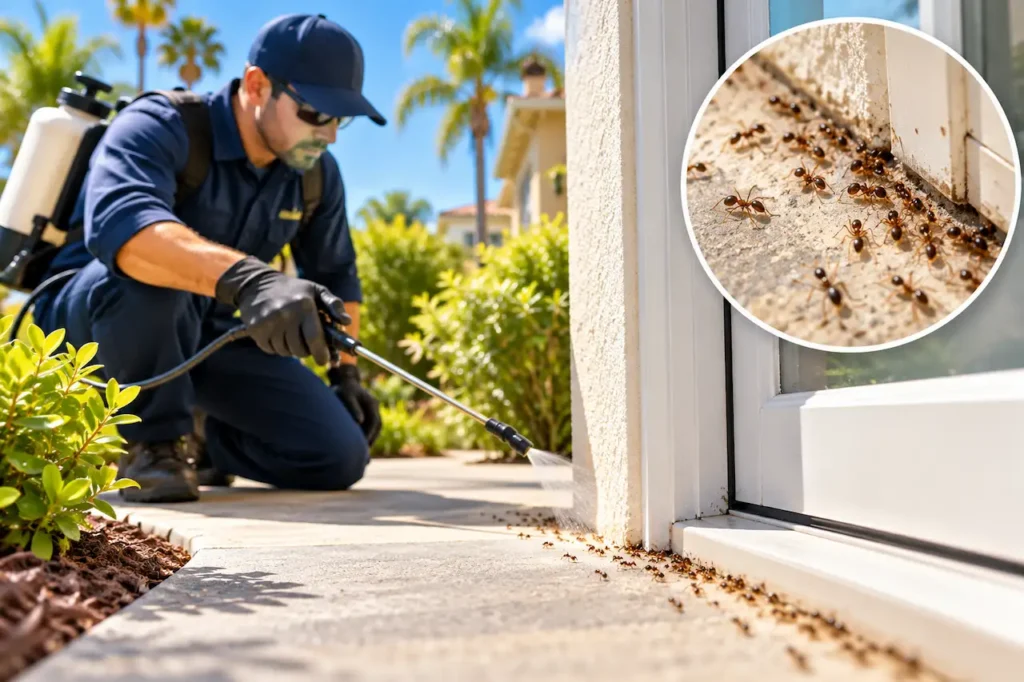
If you’ve watched a steady line of tiny brown ants marching across your kitchen counter, around your sink, or along a baseboard this summer, you’re not imagining it and you’re not alone. Across Los Angeles County and Orange County, Argentine ants in California homes spike dramatically every summer, and there’s real science behind why it happens, and why it feels like they’re impossible to get rid of.
At Impressive Exterminating Pest Control, we get calls about this exact problem from June through September, year after year, from Long Beach to Torrance to Cerritos. This guide explains what’s actually driving the ant invasion summer brings to Southern California homes, and what works to stop it.
It’s Not Just You — It’s a Supercolony
Argentine ants (Linepithema humile) aren’t native to California they arrived from South America over a century ago and have since become one of the most successful invasive species on the planet. Here’s the part most homeowners don’t know: unlike most ant species, different Argentine ant nests don’t compete with each other. Instead, they cooperate as one massive, interconnected network.
Researchers at UC San Diego have mapped Argentine ant “super colonies” stretching for hundreds of miles along the California coast, made up of millions potentially hundreds of millions of individual ants working together rather than against each other. That’s a big part of why treating what looks like “one trail” in your kitchen rarely solves the problem. You’re not dealing with an isolated nest; you’re dealing with a tiny visible piece of a much larger network.
Why Summer Specifically Triggers the Invasion
Argentine ants are unusually sensitive to both heat and moisture, and Southern California’s dry summer heat pushes them indoors for one simple reason: water. As outdoor soil dries out and their shallow nests lose moisture, ants head toward the nearest reliable water source which is almost always inside a home, not outside it.
Entomologists who study Argentine ants point to a few specific summer triggers:
- Dry, hard ground outdoors drives ants to seek moisture indoors, especially around sinks, dishwashers, bathrooms, and pet water bowls
- Irrigated landscaping (garden beds, mulch, potted plants, and lawns) right next to a house gives ants an easy, moist staging area close to your exterior walls
- Sugary residue and food sources become a secondary draw once ants are already inside searching for water
- Heat alone can push activity higher, since Argentine ants forage more actively in warm conditions
This is also why so many homeowners notice ants appear almost overnight: a colony that was perfectly content in a shaded, irrigated flower bed a week ago can shift its foraging indoors within days once conditions change.
How to Tell If It’s Argentine Ants (And Not Another Species)
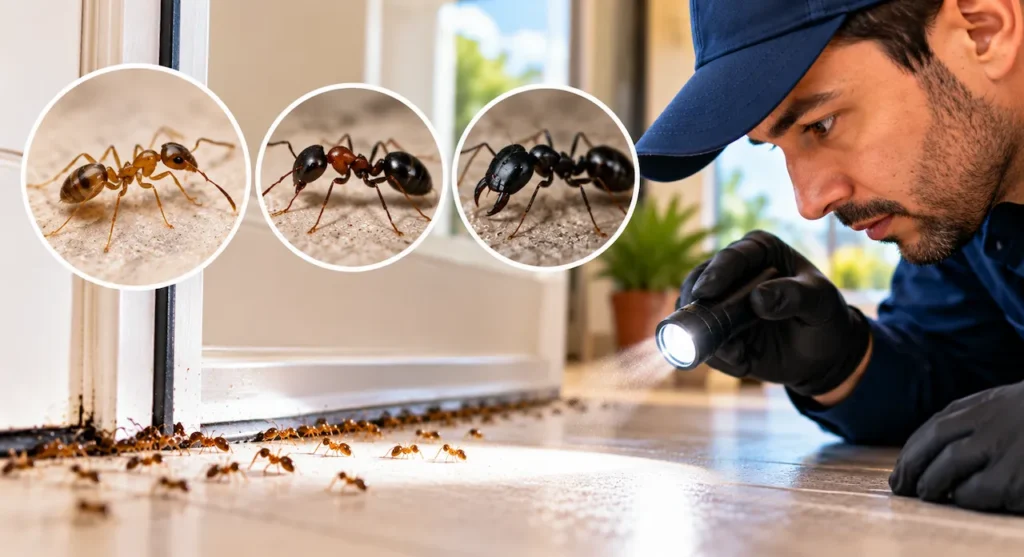
Argentine ants are small — about 1/8 inch long — light to dark brown, and move in steady, well-defined two-way trails rather than scattering randomly. A few identifying signs:
- Visible trails running along baseboards, countertops, window sills, or exterior walls, with ants moving in both directions along the same path
- Activity near moisture — sinks, bathrooms, under appliances, or around plumbing, more than near dry pantry items
- No sting, mild odor — Argentine ants don’t sting and release a faint, musty smell when crushed, unlike the stronger “rotten coconut” smell of odorous house ants, which are a common look-alike in SoCal homes
- Multiple queens per colony — this is part of why a colony can survive and rebuild quickly even after a partial treatment
Why Spraying Doesn’t Actually Fix an Argentine Ant Problem
This is the single most common mistake homeowners make, and it’s an understandable one: you see ants, so you reach for a spray. The problem is that most over-the-counter sprays kill only the visible foraging workers, a small fraction of the colony while doing nothing to the nest or the queens producing new workers.
Worse, spraying a trail can actually trigger the colony to “bud,” splitting into several smaller satellite nests scattered around your property instead of one contained colony. That’s often why spraying seems to work for a day or two, then the ants come back, sometimes in more places than before.
What Actually Works Against Argentine Ants
1. Targeted Baiting, Not Surface Spraying Slow-acting bait allows foraging ants to carry it back to the nest and share it with the rest of the colony including the queens which is the only reliable way to reduce a supercolony rather than just the ants you can see.
2. Identifying and Treating the Actual Source A proper inspection traces trails back toward their origin point — often a moist garden bed, mulch area, or irrigation line close to the foundation — rather than just treating where ants happen to be visible indoors.
3. Sealing Entry Points Argentine ants can enter through gaps as small as a crack around a window frame or utility line. Sealing these doesn’t eliminate the colony, but it reduces how easily they move indoors once the outdoor environment heats up.
4. Reducing Moisture Near the Foundation Since water is the primary driver of summer ant activity, adjusting irrigation so it doesn’t saturate soil directly against your foundation, and considering more drought-tolerant landscaping near the house, makes your property meaningfully less attractive to begin with.
5. Ongoing, Not One-Time, Treatment Because Argentine ant supercolonies span well beyond any single property, a one-time treatment rarely holds for long on its own. Recurring service that re-treats as conditions change through the summer is what actually keeps activity down season after season.
If you’re dealing with a broader pest picture this summer, not just ants. Our guide on Common Pests in Long Beach and How to Eliminate Them covers how ant activity often overlaps with other seasonal pest issues in the same households.
What Homeowners Are Actually Asking in Online Communities
We looked at what people are actually asking in homeowner communities about summer ant invasions, and the same few questions come up again and again:
Why do the ants come back a few days after I spray them?
Because spraying kills the ants you can see but leaves the nest and queens untouched and can sometimes cause the colony to split into multiple smaller nests, making the problem look worse, not better.
Are Argentine ants dangerous or just annoying?
Just annoying. Argentine ants don’t sting, don’t spread disease, and aren’t a structural threat the way termites are — the issue is almost entirely about numbers and persistence.
Why does my neighbor not have ants but I do?
Often it comes down to moisture. A yard with denser irrigation, mulch, or potted plants close to the house is a more attractive staging area for ants than a drier, more exposed one — even on the same street.
Will ants go away on their own once summer ends?
Activity typically does decrease as temperatures drop and outdoor moisture returns, but the colony itself doesn’t disappear; it simply becomes less active, which is why many homeowners see the same trails return the following summer if the underlying conditions haven’t changed.
Why This Matters Beyond Just Annoyance
While Argentine ants don’t damage your home’s structure the way termites do, an established trail into a kitchen is a food-safety and hygiene issue, and a large enough indoor presence can be genuinely difficult to live with. They’re also known to protect and “farm” aphids and other plant pests in gardens, which can affect ornamental plants and even citrus trees common in Southern California yards.
For readers dealing with ants alongside spider activity this season — the two are often connected, since spiders follow ant trails as a food source — our Spider Control page covers that overlap in more detail.
Frequently Asked Questions
What time of year are Argentine ants worst in Southern California?
Summer is the primary peak, driven by dry outdoor conditions pushing ants indoors in search of water. Some homeowners also see a secondary increase after heavy rain, when flooded outdoor nests push ants toward dry shelter.
Can I get rid of Argentine ants permanently?
Permanently eliminating an entire supercolony isn’t realistic for any single property, since colonies span across neighborhoods and even cities. What’s realistic — and effective — is ongoing treatment that keeps your specific property’s activity consistently low.
Is it safe to use ant bait around kids and pets?
Professional bait stations are designed to be enclosed and placed out of reach, making them a safer option than open sprays, which leave residue on surfaces kids and pets can contact directly.
Do Argentine ants bite?
They can bite, but they don’t sting, and bites are rare and mild compared to fire ants or other aggressive species. The bigger issue homeowners face is sheer numbers, not injury risk.
Why do I see more ants after I clean my kitchen?
Cleaning removes the food trail ants were following, so you may briefly see more erratic activity as foragers search for a new path — this usually settles once the colony reorganizes around a new route, which is part of why consistent baiting works better than one-time cleaning alone.
Does landscaping really affect how many ants get into my house?
Yes. Mulch beds, dense ground cover, and frequently irrigated planting areas directly against your foundation create ideal moisture conditions for Argentine ant nests. Adjusting irrigation timing and keeping a dry buffer zone near the foundation can measurably reduce indoor activity.
Stop the Summer Ant Invasion Before It Peaks
If Argentine ants have taken over your kitchen, bathroom, or patio this summer, Impressive Exterminating Pest Control offers free inspections across Los Angeles County and Orange County — including Long Beach, Torrance, Cerritos, Bellflower, and Downey — with targeted baiting and ongoing treatment plans built around what’s actually drawing ants to your property, not just a one-time spray.
Schedule your free ant inspection today »
Related services: Ant Control · Termite Control · Rodent Control
Related reading: