Nobody wants to be the one telling a roommate, landlord, or neighbor that they found bed bugs. The stress usually hits before the bites do. If you’re searching for the best bed bug treatment for apartments, the honest answer isn’t a store-bought spray or a rushed single visit — in nearly every multi-unit setting, the best results come from a professional inspection, a treatment plan built around shared walls, and follow-up that confirms the problem is actually gone.
Why Apartments Are Harder to Treat Than Single-Family Homes
Bed bugs don’t respect unit lines. In a multi-unit building, they can travel between apartments through wall voids, pipe penetrations, hallways, and even carried items like laundry, luggage, or used furniture. That means the best bed bug treatment for an apartment is almost never a single-product fix — it’s a coordinated plan that includes a detailed inspection, targeted treatment of hiding spots, clear preparation instructions, and monitoring of adjacent, at-risk units.
Treat one apartment while ignoring an infested neighbor, and the problem simply migrates back once the treated unit becomes attractive again.
Why DIY Treatments Usually Fail in Apartment Buildings
Over-the-counter bed bug products are marketed as quick fixes, and that’s exactly the problem. Bed bugs are exceptional at staying hidden — in mattress seams, box spring joints, behind headboards, under carpet edges, inside outlet covers. Most consumer sprays only kill on direct contact, and eggs tucked into seams or wall gaps routinely survive.
There’s a second, apartment-specific risk: heavy DIY spraying around beds and baseboards can scatter an infestation deeper into hiding or push it into an adjacent room or unit, making the problem harder and more expensive to resolve later. Foggers are a common example — they look thorough but rarely reach where bed bugs actually live, while spreading pesticide residue through living space without addressing the source.
Also Check: Monthly Pest Control Versus One-Time Treatment
The Treatments That Actually Work
Professional Heat Treatment
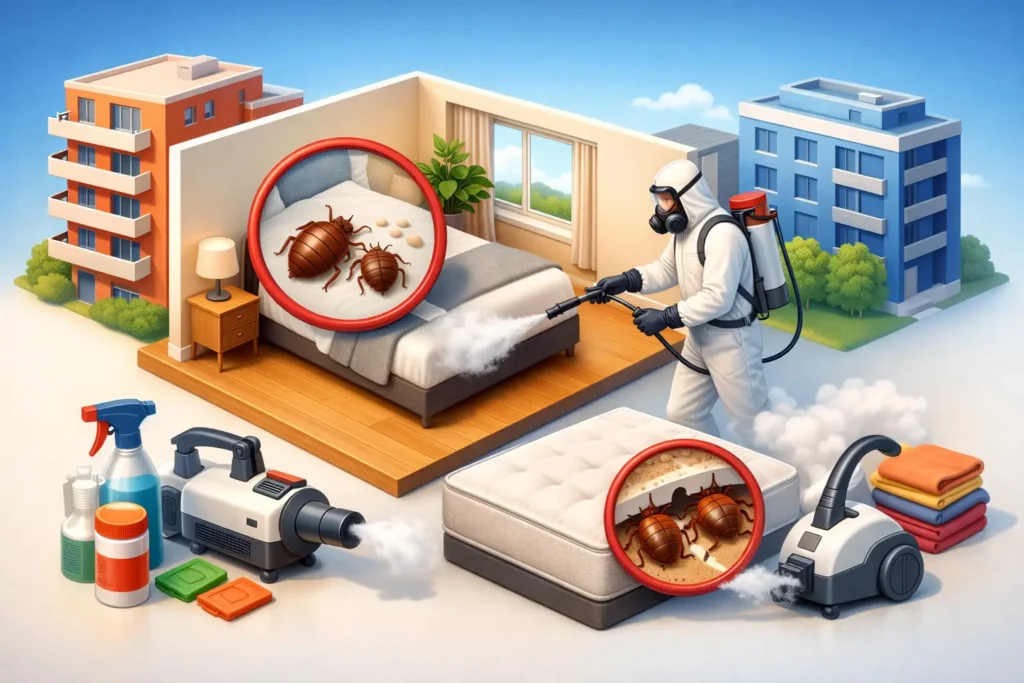
Heat is one of the most effective methods for apartment bed bug elimination when performed by trained technicians. Bed bugs and their eggs die at sustained high temperatures, and heat reaches places where sprays often can’t fully penetrate — furniture joints, mattress seams, and cluttered areas. It’s a strong option when an infestation is concentrated in one unit and fast turnaround matters, or when residents want to minimize repeated chemical applications.
The trade-off: heat treatment requires careful setup and close monitoring, particularly in apartment buildings, to avoid triggering fire sprinkler systems, damaging heat-sensitive belongings, or pushing bugs into cooler neighboring units if containment isn’t handled properly.
Typical cost: Heat treatment for a single apartment/bedroom-size area commonly runs several hundred to over a thousand dollars, depending on unit size and severity — always confirm pricing after an inspection, since blanket online estimates vary widely by market.
Targeted Conventional Treatment
A precision approach using professional-grade products focused on cracks, crevices, bed frames, upholstered furniture, and baseboards — sometimes including dust applications in wall voids or outlet areas where bed bugs travel. This is not broad spraying; it’s treatment designed specifically around bed bug behavior and apartment layout. For many residents and property managers, it offers a strong balance of effectiveness and cost.
Integrated Treatment Plans
In many real-world apartment cases, the most effective approach combines methods: targeted chemical treatment, steam in select areas, mattress and box spring encasements, interceptor monitors under bed and furniture legs, and scheduled follow-up inspections.
Bed bug elimination is rarely a single dramatic event — it’s about reducing the active population quickly, catching what was missed on the first pass, and confirming nothing survived.
Also Check: Pet Safe Ant Extermination for Your Home
Inspection Comes Before Everything Else
A proper inspection confirms where bed bugs actually are and how far they’ve spread — not just the mattress, but sofas, nightstands, wall hangings, curtain folds, baseboards, and nearby clutter. If the unit shares walls with neighboring bedrooms or living spaces, those units may need inspection too. Skipping this step is the single most common reason DIY and even some professional treatments fail: the source was never fully mapped.
Preparing an Apartment for Treatment
Good preparation improves outcomes significantly, and it doesn’t mean throwing everything away — unnecessary disposal can actually spread bed bugs through hallways, laundry rooms, or dumpsters, while adding cost without fixing anything.
Typical, effective prep includes:
- Laundering and heat-drying affected fabrics (bedding, clothing near the infestation)
- Reducing clutter around sleeping areas so technicians can access hiding spots
- Bagging cleaned items properly to prevent re-contamination
- Making beds and furniture accessible before the technician arrives
Follow the technician’s specific instructions closely — clear, simple preparation guidance leads directly to better treatment results.
Who’s Responsible: Tenant or Landlord?
This is one of the most common questions renters and property managers search for, and the general answer under most state and local housing codes (including California) is that landlords are responsible for maintaining a habitable unit, which includes arranging professional pest control for infestations like bed bugs — regardless of how the infestation started. Tenants, in turn, are generally expected to report suspected bed bugs promptly and cooperate with inspection and treatment (allowing access, following prep instructions).
Bed bugs are not a sign of poor housekeeping — they’re excellent hitchhikers and can be introduced through travel, secondhand furniture, or simply visiting a building that has an active infestation. Blame rarely helps; fast reporting and professional treatment do.
Also Check: Residential Pest Control Guide for Safer Homes
How Property Managers Should Handle Bed Bug Reports
Speed matters more than almost anything else. Waiting even a couple of weeks can turn one unit’s problem into a building-wide one. The strongest response:
- Take every report seriously and schedule an inspection quickly — don’t assume where the infestation started.
- Inspect adjacent units, not just the reporting unit.
- Document everything: inspection findings, treatment dates, and follow-up visits.
- Communicate clearly and consistently with affected residents; a simple, calm process improves tenant cooperation and outcomes.
How Long Does Full Elimination Actually Take?
It depends on severity and method. Some apartments resolve after one major treatment plus a single follow-up visit. Others — especially where bed bugs have reached furniture, wall voids, or neighboring units — need multiple visits over several weeks. Eggs can hatch after an initial treatment, so residents may still see occasional activity for a short period; that doesn’t automatically mean the treatment failed, but it does mean the case needs to be tracked, not closed after one visit.
Choosing the Right Provider
Look for a company that offers inspection-based treatment (not blind quoting), real experience with apartment and multi-unit properties, safe methods appropriate for occupied living spaces, and clear prep/follow-up instructions. Licensing and responsive scheduling matter especially when tenants are involved.
Impressive Exterminating provides inspection-driven bed bug treatment for apartments and multi-unit properties across Los Angeles County and Orange County, with a focus on long-term resolution — not a one-time spray and a hope. Call (562) 246-9044 for a free inspection.
Frequently Asked Questions
What is the fastest way to get rid of bed bugs in an apartment?
Professional heat treatment is generally the fastest single-visit option, since it can kill bed bugs and eggs throughout a room in one treatment cycle rather than requiring repeated visits. However, “fastest” isn’t always “most cost-effective” — a targeted conventional treatment plan with proper follow-up can achieve full elimination over a slightly longer timeline at a lower cost, which is often the better fit for a contained, early-stage infestation.
How much does bed bug treatment cost for one apartment?
Costs vary by unit size, severity, and method, but professional treatment for a single apartment commonly ranges from a few hundred dollars for targeted conventional treatment of a contained infestation up to $1,000+ for heat treatment of a full unit. Always get a written estimate after an inspection rather than relying on a phone quote.
Is the landlord or the tenant responsible for paying for bed bug treatment?
In most jurisdictions, including California, landlords are generally responsible for arranging and paying for professional pest control to address bed bug infestations, as part of maintaining a habitable rental unit — regardless of how the bed bugs were introduced. Lease agreements sometimes include a bed bug addendum outlining tenant responsibilities (reporting promptly, cooperating with prep and access), but this typically doesn’t shift the cost of professional treatment onto the tenant unless negligence can be shown. Check your specific lease and local housing code, since rules can vary by city.
Can bed bugs spread to other apartments through walls?
Yes. Bed bugs can travel through wall voids, pipe penetrations, electrical conduits, and shared hallways, and they can also be carried between units on furniture, luggage, or laundry. This is exactly why a single-unit treatment plan without inspecting adjacent units often fails to fully resolve a building’s infestation.
Do I have to throw away my mattress or furniture if I have bed bugs?
Not necessarily. Mattresses and box springs can often be treated and then sealed in a certified bed bug encasement rather than discarded. Throwing away infested furniture without proper bagging can actually spread bed bugs through hallways and shared disposal areas, so it’s worth asking a technician what genuinely needs replacement versus what can be treated and kept.
How can I tell if I actually have bed bugs and not another bug?
Common signs include small reddish-brown insects roughly the size of an apple seed, tiny dark reddish-brown fecal spots on mattress seams or baseboards, small blood stains on sheets, shed skins near sleeping areas, and clusters of itchy bites (often in a line) after sleeping. Because several other insects can be mistaken for bed bugs, a professional inspection is the most reliable way to confirm before starting treatment.
How many treatments does it usually take to fully get rid of bed bugs in an apartment?
Most professional plans include at least one initial treatment and one follow-up visit two to three weeks later, since bed bug eggs can survive an initial treatment and hatch afterward. More severe or spread-out infestations may need three or more visits. A provider that promises full elimination in a single visit with no follow-up plan is setting expectations that don’t match how bed bug biology actually works.