Quick answer: Small, fully exposed paper wasp nests far from doors and foot traffic can sometimes be treated with a labeled wasp spray applied from a safe distance in the evening. Large nests, hidden nests (in walls, attics, or the ground), or any nest near an entryway, play area, or someone with a sting allergy should go to a licensed wasp control professional rather than a DIY attempt.
A wasp nest over a front door, beside a patio, or near a business entrance can turn an ordinary day into a real safety concern. Knowing how to get rid of wasp nests safely starts with one rule: do not rush toward the nest with a spray can or a broom. Wasps defend their colony when they sense a threat, and a quick DIY attempt can lead to multiple stings, property damage, or a more difficult infestation.
For homeowners, landlords, and business owners across Los Angeles County and Orange County, the right response depends on the nest’s size, location, activity level, and the people who may be exposed. A small, early-season nest in an open area may be manageable with care. A large nest in a wall, roofline, tree, attic, or high-traffic location is usually a job for a licensed pest control professional.
First, Keep Your Distance and Assess the Nest
Do not stand directly beneath or in front of a nest to inspect it. Watch from a safe distance and look for the flight path of the wasps. If you see steady traffic entering and leaving one spot, the colony is active. Activity often increases during warm Southern California afternoons, so avoid approaching the area during that time.
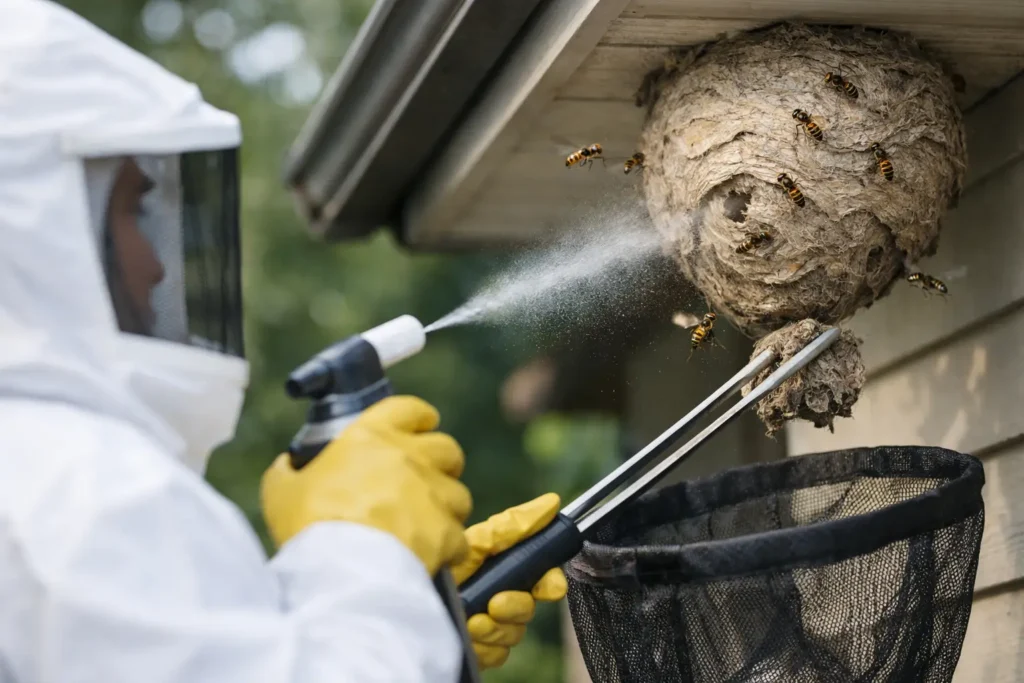
Paper wasps typically build open, umbrella-shaped nests under eaves, patio covers, fences, and outdoor fixtures — common on the older, eave-heavy home styles found throughout Torrance and Long Beach. Yellowjackets may nest in the ground, inside walls, or in other enclosed spaces, making them especially difficult to remove safely. Hornet-like nests are often enclosed and can grow large in trees, shrubs, or rooflines.
The nest location matters as much as its size. A small nest far from people may not pose an immediate problem. A nest near a child’s play area, pool, doorway, outdoor dining space, loading area, or tenant walkway needs prompt attention. If someone in the household or workplace has a known allergy to stinging insects, treat any active nest as a higher-risk issue.
When You Should Not Try DIY Wasp Nest Removal
DIY removal is not the safe choice in many situations. Call a professional if the nest is larger than a golf ball, difficult to reach, inside a structure, or located where people regularly pass by. You should also avoid handling it yourself if you cannot clearly identify where wasps are entering, because treating the visible activity without addressing the nesting site can leave part of the colony behind.
Never attempt to knock down, burn, flood, or seal up an active nest. Burning creates a fire hazard. Flooding rarely solves the problem and can agitate the colony. Sealing an entry point while wasps are still inside can drive them into wall voids, attics, or occupied rooms.
Do not remove a nest if you are allergic to wasp venom, have a history of severe reactions, lack protective clothing, or need to use a ladder. One sting can cause a serious reaction for sensitive individuals. A fall from a ladder while trying to escape a swarm can be just as dangerous.
How to Get Rid of Wasp Nests Safely in Low-Risk Situations
If the nest is very small, fully exposed, easily accessible from the ground, and far from doors, windows, pets, and people, cautious DIY treatment may be reasonable. Even then, use a product specifically labeled for wasp and hornet nest treatment and follow every label instruction. The product label is the safety standard for application distance, protective equipment, timing, and disposal.
Plan before you begin:
- Keep children, pets, and bystanders indoors and close nearby windows.
- Make sure you have a clear escape route and don’t trap yourself in a corner, on a ladder, or behind patio furniture.
- Wear long sleeves, long pants, closed-toe shoes, gloves, and eye protection — avoid loose clothing a wasp could get trapped inside.
- Treat only in the evening or very early morning, when wasp activity is lower and more of the colony is likely inside the nest.
- Stand as far away as the product directions allow, never directly beneath the nest.
- Apply the treatment as directed, then leave the area immediately — don’t stand nearby to watch the results.
Wait at least 24 hours, or the length of time specified on the label, before checking for activity from a distance. If wasps are still entering or leaving, do not repeatedly spray the nest — that can increase agitation without eliminating the colony. At that point, professional treatment is the safer and more effective next step.
Once there has been no activity for the recommended period, the inactive nest can be carefully removed and placed in a sealed trash bag. Wear protective clothing during removal. Clean the surrounding surface to remove residue and inspect the area for openings, gaps, or conditions that could attract wasps back.
Why Hidden Nests Need Professional Treatment
A nest inside a wall, attic, soffit, chimney, or ground cavity is different from one hanging in plain sight. The visible opening may only be one access point to a much larger colony. Treating it incorrectly can force wasps further into the building or cause them to find another way indoors.
Professionals identify the species, locate the nesting area, use appropriate treatment methods, and address the entry points after activity has stopped. This approach matters for apartment buildings, rental homes, restaurants, offices, warehouses, and other commercial properties where a sting incident can affect tenants, employees, customers, and operations — a common concern for property managers in dense areas like Alhambra and Anaheim.
A professional also helps avoid a common mistake: removing the nest but ignoring the reason it was there. Wasps are drawn to protected shelter, food residue, sweet drinks, overflowing trash, fallen fruit, and exterior gaps. Long-term control requires more than taking down one nest.
Prevent Wasps From Building New Nests
After removal, walk around the exterior of the property and look at eaves, patio covers, vents, fences, sheds, outdoor lighting, and roof edges. These protected spots are common early-season nesting areas. Catching a small new nest before it grows is much safer than dealing with a mature colony later in the summer.
Keep outdoor trash containers closed and clean up spills quickly, especially around grills, outdoor kitchens, break areas, and dumpsters. Rinse recyclable cans and bottles before placing them outside. If fruit trees are on the property, remove fallen fruit regularly. At businesses, make sure waste areas are serviced consistently and food-handling zones are kept clean.
Seal gaps around utility lines, vents, fascia boards, and siding once all wasp activity has ended. Repair damaged screens and weather stripping around doors and windows. These simple exclusion steps reduce the chance that wasps will move into a wall void or attic.
For properties with repeat wasp activity, scheduled pest maintenance can provide early monitoring and fast treatment before nests become a larger safety problem. Impressive Exterminating provides inspection-driven wasp control for homes and businesses throughout Los Angeles County and Orange County, with treatment plans tailored to the nest location and level of activity.
What to Do If Someone Is Stung
Move away from the area calmly to avoid more stings. Wash the sting site with soap and water, apply a cold pack wrapped in a cloth, and monitor symptoms. Local pain, redness, and swelling are common, but symptoms such as trouble breathing, swelling of the face or throat, dizziness, widespread hives, or vomiting require emergency medical care right away.
A wasp nest does not always require panic, but it does require good judgment. If the nest is active, hidden, high up, or anywhere people could be stung, choosing fast professional help protects your family, tenants, customers, and property without adding unnecessary risk.
Frequently Asked Questions
Is it safe to spray a wasp nest with soapy water instead of pesticide?
A strong soap-and-water mixture can suffocate wasps in a small, exposed nest by clogging their breathing pores, and many homeowners use it as a lower-toxicity option. It only works reliably on small paper wasp nests you can safely reach from a distance — it is not a safe or effective method for yellowjacket nests in walls, ground burrows, or large hornet nests, which should go to a professional.
What time of day is safest to treat a wasp nest?
Treat in the evening or very early morning when wasp activity is lowest and most of the colony is inside the nest. Never treat during peak daytime heat, when foraging wasps are most active and most likely to defend the colony aggressively.
Why shouldn’t I just knock the nest down?
Knocking down, burning, or flooding a nest agitates the entire colony at once instead of controlling it, which dramatically increases the chance of multiple stings. It also rarely removes the queen or the full nest structure, so wasps often rebuild nearby within days.
How do I know if it’s paper wasps, yellowjackets, or hornets?
Paper wasps build small, open, umbrella-shaped nests you can see the individual cells in. Yellowjackets often nest in the ground, in wall voids, or other enclosed cavities and are the most aggressive of the three. Bald-faced hornets build large, fully enclosed, papery nests in trees or on rooflines. Because enclosed and hidden nests are harder to treat safely, species ID often determines whether DIY is realistic at all.
How much does professional wasp nest removal cost in Los Angeles / Orange County?
Cost depends on nest size, location (ground vs. wall void vs. roofline), and accessibility, since hidden or elevated nests require more time and equipment. A free inspection is the most reliable way to get an accurate quote for your specific property.
Will wasps come back to the same spot after the nest is removed?
Wasps won’t reuse an old nest, but new colonies are often drawn back to the same eaves, vents, or gaps that made the first nest possible. That’s why exclusion — sealing entry points and removing food/moisture sources — matters as much as removing the nest itself.