If you’ve heard scratching in your attic at night, there’s a good chance it’s one of two rats: the roof rat or the Norway rat. Both are common across Los Angeles County and Orange County, but they behave very differently and knowing which one you’re dealing with changes where to look, how to get rid of it, and how to keep it from coming back. Here’s the fast way to tell them apart, plus what to do next.
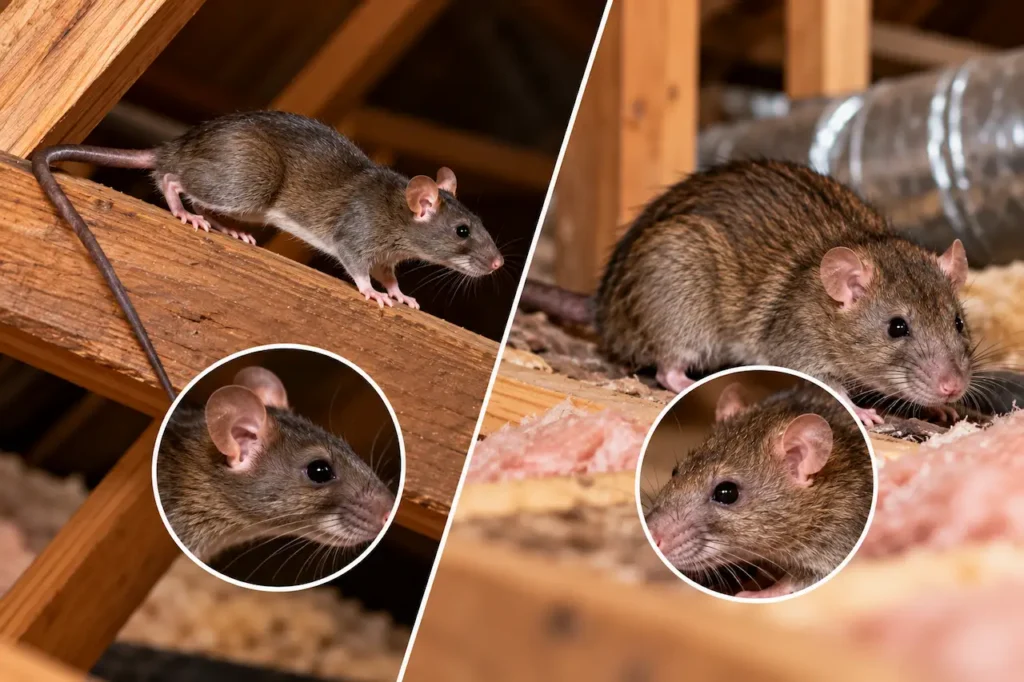
Roof rats are slender, excellent climbers with tails longer than their bodies, and they nest up high — attics, palm trees, roof voids, and upper wall spaces. Norway rats are larger, stockier, and poor climbers, and they nest down low burrows, crawl spaces, garages, and near foundations.
If the noise is coming from your attic or ceiling, it’s almost always a roof rat. If it’s coming from under the house, the garage, or the yard, it’s more likely a Norway rat.
Why This Distinction Matters in Southern California
Los Angeles and Orange County have healthy populations of both species, and mature landscaping — palm trees, citrus trees, dense hedges, and overhanging power lines — gives roof rats an easy highway straight into attics and rooflines. Treating the wrong species, or treating only the symptom instead of the entry point, is one of the most common reasons DIY rat control fails and infestations come back within weeks.
Roof Rat Identification (Rattus rattus)
Also called black rats or ship rats, roof rats are the species most commonly found inside SoCal attics.
- Size: 6–8 inches body length, with a tail that’s longer than the body (total length up to 16 inches)
- Build: Slender, with large ears and a pointed nose
- Color: Typically black to dark brown/gray
- Behavior: Excellent climbers — they travel along power lines, fences, and tree branches, and can enter a home through gaps as small as a quarter-inch near the roofline
- Preferred nesting spots: Attics, soffits, palm tree crowns, dense ivy, and upper wall voids
Signs of roof rats specifically: droppings concentrated in the attic or upper walls, gnaw marks on roof rafters or attic wiring, greasy rub marks along roofline entry points, and scratching sounds that seem to come from directly above you at night.
Norway Rat Identification (Rattus norvegicus)
Also called brown rats or sewer rats, Norway rats are the species you’re more likely to find around your foundation, yard, or garage.
- Size: Larger and stockier than roof rats, 7–9.5 inches body length, with a tail shorter than the body
- Build: Heavy-bodied, small ears, blunt nose
- Color: Brown to gray, often with a lighter belly
- Behavior: Strong diggers, poor climbers — they burrow at ground level rather than nesting up high
- Preferred nesting spots: Burrows near foundations, under sheds, in crawl spaces, woodpiles, and dense ground cover
Signs of Norway rats specifically: burrow holes along fence lines or foundations, gnawing near ground-level entry points (garage doors, foundation vents), and droppings concentrated in garages, basements, or crawl spaces rather than the attic.
Side-by-Side Comparison Roof Rats vs Norway Rats
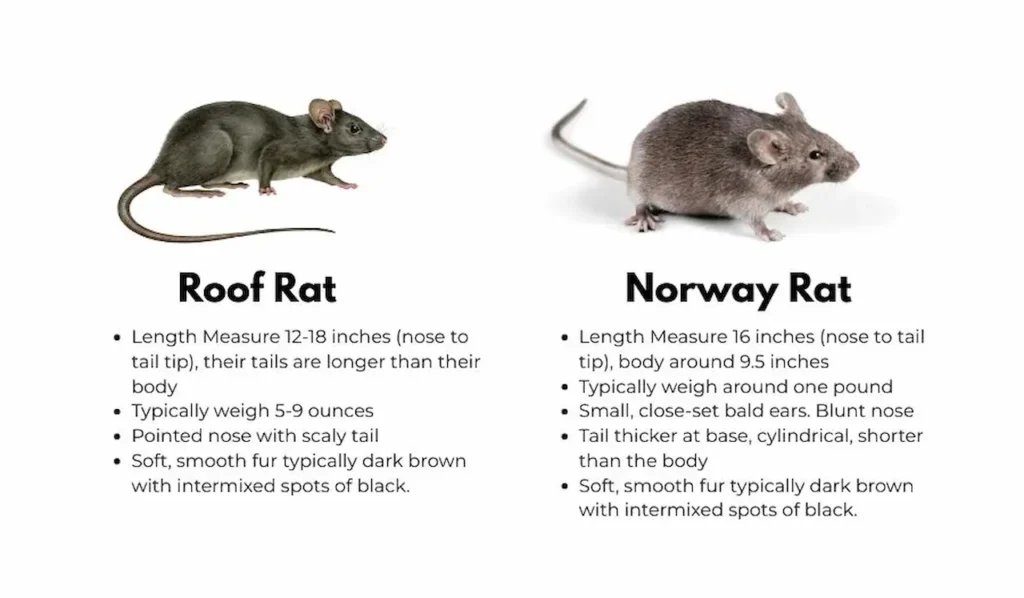
| Feature | Roof Rat | Norway Rat |
| Typical location | Attics, rooflines, trees | Burrows, crawl spaces, garages |
| Body vs. tail | Tail longer than body | Tail shorter than body |
| Build | Slender | Stocky, heavy-bodied |
| Climbing ability | Excellent climber | Poor climber, strong digger |
| Common SoCal habitat | Palm trees, dense hedges, power lines | Ground burrows, woodpiles, foundations |
| Most common entry point | Roofline gaps, eaves, vents | Foundation gaps, garage doors, ground-level openings |
Other Clues: What Their Droppings and Damage Tell You
If you can’t get a clear visual, droppings and damage patterns are often the fastest way to tell the two apart:
- Roof rat droppings are spindle-shaped with pointed ends, usually found scattered in attic insulation or along rafters.
- Norway rat droppings are larger, blunt-ended, and capsule-shaped, typically found near ground-level nesting sites.
- Chewed wiring in the attic points strongly toward roof rats, since Norway rats rarely nest that high.
- Burrow holes in the yard, especially near foundations or under sheds, point strongly toward Norway rats.
What Homeowners Actually Asking
We pulled together the questions that come up most often in homeowner forums and local community threads about attic rats in Southern California:
“I hear scratching only at night in my ceiling — is that normal for rats?”
Yes. Both roof rats and Norway rats are nocturnal, so nighttime scratching, especially in the attic or wall voids, is a classic sign of an active infestation rather than a one-time visitor.
“Do roof rats really live in palm trees?”
Yes — mature palm trees with heavy frond skirts are one of the most common roof rat nesting sites in Southern California, and untrimmed fronds near a roofline give them a direct path into the attic.
“Can I just use traps myself, or do I need a professional?”
Snap traps can work for a small, newly discovered issue, but they only address the rats present at the time they don’t seal the entry points that let new rats in. Most recurring infestations come back because the access point (a roofline gap, an open vent, a foundation crack) was never sealed.
“Is it dangerous to have rats in my attic?”
Yes, beyond the noise. Rats gnaw on electrical wiring (a fire hazard), contaminate insulation with droppings and urine, and can carry fleas, mites, and disease. Roof rats in particular are associated with damage to attic wiring since that’s exactly where they nest.
“Will homeowners insurance cover rat damage in my attic?”
Typically no. Most standard homeowners policies treat rodent damage as a preventable maintenance issue rather than a covered event, which is why catching an infestation early and sealing entry points matters more than relying on insurance after the fact.
Frequently Asked Questions
How do I know if it’s a roof rat or a mouse in my attic?
House mice are much smaller (5–8 inches including tail) with proportionally larger ears relative to their head size, while roof rats are noticeably larger with a longer tail. Droppings are also a giveaway — mouse droppings are tiny (about the size of a grain of rice), while roof rat droppings are larger and spindle-shaped.
Can roof rats and Norway rats be in the same house at the same time?
It’s uncommon but possible, especially on larger properties with both mature trees and ground-level clutter. A thorough inspection checks both the attic and the perimeter/foundation rather than assuming only one species is present.
What attracts roof rats to attics specifically?
Warmth, shelter, and easy access are the main draws — overhanging tree branches, untrimmed palm fronds, roofline gaps, and vents without proper screening all make a roofline an easy target.
How much does it cost to get rid of rats in an attic?
Cost depends on the extent of the infestation and how many entry points need to be sealed. A professional inspection is the most reliable way to get an accurate estimate for your specific property rather than guessing based on trap costs alone.
How long does it take to get rid of an attic rat infestation?
It varies by severity, but full resolution typically requires trapping the rats currently inside, sealing every entry point, and monitoring for a period afterward to confirm no new activity — a one-time trap-and-done approach usually isn’t enough for an established colony.
Do ultrasonic repellents actually keep roof rats away?
There’s limited reliable evidence that ultrasonic devices meaningfully reduce rat activity in real homes. Sealing entry points and removing nesting conditions (overhanging branches, debris piles) remains the most consistently effective approach.
How Impressive Exterminating Handles Roof Rats and Norway Rats Differently
Because these two species nest in completely different parts of a property, treating them the same way rarely works. Our rodent control process starts with identifying which species — or both — you’re actually dealing with:
- Inspection of both the attic/roofline and the ground-level perimeter, not just one or the other
- Species-specific trapping placed where each type of rat actually nests and travels
- Entry point sealing — roofline gaps and vent screening for roof rats, foundation and ground-level gaps for Norway rats
- Follow-up monitoring to confirm the infestation is fully resolved, with our guarantee to return if activity is found again
If you’re hearing activity in your attic, walls, or yard anywhere in Long Beach, Torrance, Cerritos, Downey, Carson, Bellflower, or the surrounding Los Angeles and Orange County communities, it’s worth having it identified properly before choosing a treatment approach.
Related Reading
- Rodent Control Strategies for Rolling Hills Estates
- The Importance of Regular Pest Inspections in Long Beach
- Common Pests in Long Beach and How to Eliminate Them
Explore Our Related Services
Not Sure Which Rat You’re Dealing With? Let Us Confirm It.
Guessing wrong on species means treating the wrong part of your house. Impressive Exterminating offers free inspections across Los Angeles County and Orange County — we’ll identify exactly what’s in your attic or yard, show you the entry points, and recommend a treatment plan built around the species actually causing the problem, backed by our return guarantee.