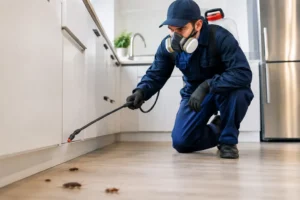
A bed bug sighting in a guest room and termite damage inside a wall stud can both feel like emergencies — but they don’t call for the same solution. When people search “fumigation versus heat treatment,” they’re usually trying to figure out which method actually applies to what they’re dealing with, not just which one sounds more thorough. The right choice depends on the pest, how far the infestation has spread, the property’s layout, and how fast you need to use the space again.
Both methods can be highly effective in the hands of licensed professionals — they just solve very different problems. For homeowners, landlords, and business owners across Los Angeles County and Orange County, a professional inspection should always come before a treatment decision. The goal isn’t just eliminating what you can see. It’s finding where the pests are actually hiding, stopping the active infestation, and lowering the odds of an expensive repeat.
How Fumigation Works
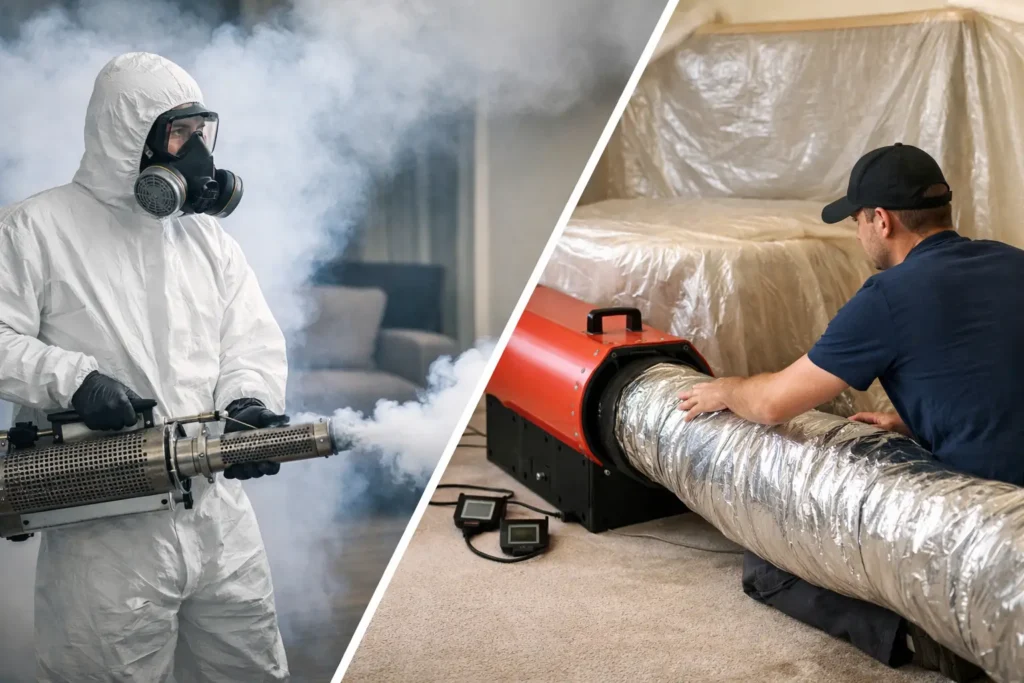
Fumigation is a whole-structure treatment that uses a regulated gas — commonly sulfuryl fluoride, often called by the brand name Vikane — to penetrate areas that sprays and localized treatments can’t reach. A licensed fumigation crew seals the structure with tarps, introduces the fumigant under strict safety protocols, and keeps the property closed until treatment is complete and the air has been fully cleared for reentry.
This method is most associated with drywood termites, which can live deep inside framing, trim, attic wood, and cabinetry. When activity is widespread or scattered across several parts of a home, spot treatments risk leaving hidden colonies behind untouched. Fumigation treats the entire structure at once, which is why it remains the most dependable option for broad drywood termite activity.
Fumigation is occasionally used for certain stored-product pests or severe infestations that require complete penetration, but it isn’t a routine answer for every pest problem. Rodents, ants, cockroaches, and moisture-related pests generally need a targeted plan built around exclusion, sanitation, monitoring, and ongoing service instead.
What to Expect During Structural Fumigation
A structural fumigation takes real planning. Residents, pets, plants, and consumable items have to be handled exactly according to the preparation instructions from your licensed provider — our detailed guide on preparing for fumigation walks through this step by step. The building must be fully vacant during treatment, typically for two to three days depending on the structure’s size, the treatment plan, and the clearance process.
That temporary disruption is the trade-off. In exchange, fumigation delivers coverage throughout the entire structure and leaves no surface residue once the property has been properly aerated. One detail worth knowing before you book: fumigation eliminates the termites present at the time of treatment, but it doesn’t create ongoing protection against a new colony moving in afterward. That’s why many providers pair fumigation with follow-up prevention — sealing entry points, correcting moisture issues, and scheduling future inspections.
For rentals, commercial buildings, and multi-unit properties, scheduling and communication matter as much as the treatment itself. Property managers need to coordinate access, notify occupants well in advance, and plan around business operations, since a tenant returning early — or leaving a pet behind — can delay the entire job.
How Heat Treatment Works
Heat treatment raises the temperature inside an enclosed space to a level that’s lethal to pests, while specialized equipment circulates heated air and technicians monitor temperatures throughout the zone. The goal is reaching effective temperatures not just in open rooms, but inside furniture, cracks, seams, wall voids, and every other hiding place.
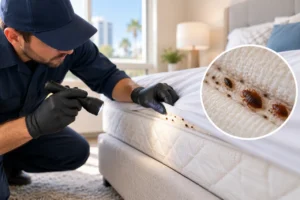
Heat is most often used for bed bug control. Bed bugs hide in mattress seams, bed frames, upholstered furniture, baseboards, picture frames, and small gaps near sleeping areas, making them difficult to reach with sprays alone. A properly performed heat treatment can eliminate bed bugs at every life stage, including eggs — which is exactly why pest researchers and entomology departments consistently describe heat as one of the most effective non-chemical control methods available for this specific pest.
Heat treatment is generally more targeted than fumigation. A technician might treat a single bedroom, several hotel rooms, one office, or another clearly defined area, which makes it a practical choice when the problem is contained and a full-building treatment would be overkill.
What to Expect During Heat Treatment
Heat treatment usually involves less time away from the property than fumigation, though occupants and pets still need to leave during service. Many jobs finish in a single day, with reentry possible once the treated area has cooled and the technician confirms it’s safe.
Preparation still matters. Heat-sensitive belongings, aerosols, candles, certain cosmetics, medications, plants, and anything that could warp or melt under high heat may need to be removed. Technicians often ask you to reduce clutter beforehand so heat can circulate properly around furniture and personal items — one detail pest professionals emphasize repeatedly: clutter is the single biggest reason a heat treatment underperforms, because it creates cool pockets heat can’t reach.
The biggest advantage is speed and the fact that it’s an active, physical kill method rather than a residual chemical one. The limitation is that heat has to be carefully managed. Rooms with poor airflow, heavy clutter, thick walls, or complex construction may need extra monitoring or a follow-up visit to confirm every hiding spot reached lethal temperature.
Fumigation vs. Heat Treatment for Termites
For drywood termites, fumigation is usually the more complete choice when activity is widespread, hidden, or scattered across multiple areas of the structure — it reaches termites inside enclosed wood that a technician simply can’t access with a localized product.
Heat can work for certain termite situations, especially when the infestation is truly limited to one specific area — a single wall section, an attic space, or a piece of furniture. It can be a practical way to avoid tenting an entire building. But localized termite heat treatment isn’t automatically the right move. If an inspection turns up evidence of termites in several disconnected locations, treating only the one you can see risks a false sense of security. The real question is whether the infestation is genuinely isolated, or simply not yet visible elsewhere.
Fumigation vs. Heat Treatment for Bed Bugs
Heat treatment is the more natural fit for bed bugs in the overwhelming majority of cases. It’s designed to reach pests hiding throughout a room and can kill bed bugs quickly once the required temperature is achieved and held throughout the space.
Fumigation is rarely the first recommendation for a typical bed bug infestation — it involves far more disruption than most bed bug cases require. Bed bug problems are usually better handled with heat, targeted applications, careful inspection, and follow-up monitoring instead.
For apartments, hotels, and multi-unit housing, bed bug control often needs to extend beyond the reported unit. Bed bugs travel through wall voids, utility openings, and shared spaces, so treating one room without checking adjacent units can let the infestation quietly continue next door.
Safety, Cost, and Convenience Factors
Neither treatment should be chosen on price alone. Fumigation typically costs more upfront because it involves whole-structure sealing, licensed gas application, extended vacancy, and formal clearance procedures — but it can be more cost-effective than repeated spot treatments once drywood termites are established throughout a property.
Heat treatment tends to be less disruptive and can return a room to service faster, though pricing depends on the size of the treatment area, the amount of furniture and clutter, access requirements, and the monitoring needed to confirm every hiding place reached a lethal temperature.
Safety, in both cases, comes down to professional preparation and execution. A licensed pest control company should give you clear instructions, secure the treatment area, use proper monitoring equipment, and confirm exactly when it’s safe to return. Never attempt either process with rental heaters, unlicensed providers, or DIY chemicals — both methods carry real safety risks when handled incorrectly.
Start With the Pest, Not the Method
The best treatment decision starts with an accurate diagnosis, not a preference for one method over the other. Drywood termite pellets, damaged wood, live insects, bed bug bites, shed skins, and dark spotting can all point toward a problem, but none of them tell the complete story on their own. A trained inspection identifies the actual pest, how far activity has spread, and the conditions that let it develop in the first place.
Impressive Exterminating helps property owners across Los Angeles County and Orange County make informed treatment decisions with customized plans, clear preparation guidance, and dependable follow-up. Whether you’re dealing with termites in structural wood or bed bugs disrupting a home, rental, or business, the right solution should protect the property without creating more disruption than necessary.
A fast response matters — but choosing the right treatment matters more. Schedule a professional inspection as soon as you notice signs of activity, so your treatment plan is built on evidence instead of guesswork.
Frequently Asked Questions
Is heat treatment or fumigation better for bed bugs?
Heat treatment is almost always the better fit for bed bugs. It reaches every life stage, including eggs, without the extended vacancy and whole-structure disruption that fumigation requires. Fumigation is reserved for the rare bed bug case where an infestation has spread too extensively for heat alone.
How long do you have to stay out of the house during fumigation?
Most residential structural fumigations require the property to be vacant for around two to three full days, though this can range from roughly 24 hours to a week depending on the size of the structure, the fumigant used, and the extent of the infestation. Your licensed provider will give you an exact timeline for your specific property — don’t rely on a neighbor’s experience or a generic online estimate.
Does fumigation protect my house from termites coming back?
No. Fumigation eliminates the termites present in the structure at the time of treatment, but it doesn’t leave any residual barrier that prevents a new colony from moving in later. Ongoing protection typically requires separate prevention steps — sealing entry points, correcting moisture problems, and scheduling periodic inspections or a monitoring program.
Can I stay in one room while the rest of the house is being fumigated?
No. Structural fumigation requires the entire property to be completely vacant — people, pets, and plants included — for the full duration of treatment and clearance. There’s no way to safely occupy any part of a structure while it’s sealed and filled with fumigant gas.
Is heat treatment safe for a home with kids or pets?
Yes, when performed by licensed professionals, but everyone — including pets — still needs to leave the treated area during service, since the temperatures used are unsafe for people and animals, not just pests. Heat-sensitive items also need to be removed beforehand per your provider’s instructions.
How much does bed bug heat treatment cost compared to chemical treatment?
Heat treatment generally costs more per visit than a single chemical application, but it often resolves an infestation in fewer visits since it kills eggs on contact — something many residual sprays can’t reliably do. Total cost depends on the size of the treatment area and the extent of the infestation, so an inspection is the most accurate way to get a real number.
What’s the difference between whole-house fumigation and localized heat treatment?
Fumigation treats an entire sealed structure with gas and is built for infestations spread throughout a building. Localized heat treatment targets one specific room or area and is built for contained problems. The right choice depends entirely on how widespread the infestation actually is, which is why an inspection — not a guess — should drive the decision.
Can bed bugs survive heat treatment?
Properly performed heat treatment that reaches and holds lethal temperatures throughout every hiding spot in the treatment zone is highly effective against all bed bug life stages. Survivors are almost always the result of incomplete heat coverage — often caused by heavy clutter blocking airflow — rather than bed bug resistance to heat itself. This is why pre-treatment decluttering matters as much as the equipment used.