Noticing bees flying around your roof, hovering near your windows, or gathering in one spot in your yard can be concerning. You might see only a few bees visiting flowers, or you might suddenly notice dozens clustering beneath your roofline.
The reason bees gather around your house depends on what they are doing. They may be searching for nectar, collecting water, looking for shelter, or scouting a location for a new colony. Repeated activity around the same opening can also indicate an established hive nearby.
For homeowners in Los Angeles County and Orange County, understanding the difference is important. Southern California’s relatively mild climate allows many bee species to remain active throughout much of the year.
This guide explains why bees gather around houses, what their behavior can tell you, and when professional bee control may be necessary.
Why Are Bees Gathering Around Your House?
Bees usually visit residential properties because they have found food, water, shelter, or a potential nesting location. Identifying the reason can help you decide what to do next.
1. Flowers and Other Food Sources Are Attracting Bees
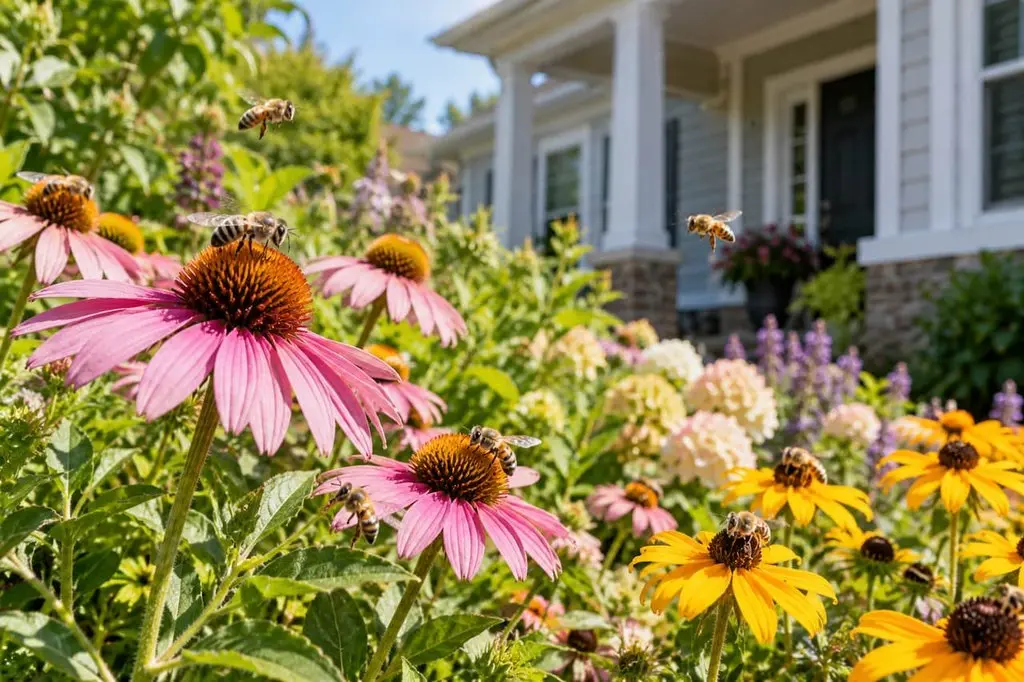
Flowering plants, fruit trees, flowering shrubs, and vegetable gardens provide nectar and pollen that bees need to survive.
If you frequently see bees moving between flowers, visiting blossoms, and flying away, they are probably foraging rather than nesting.
Fallen fruit, sugary spills, and exposed sweet liquids can also attract some bees.
What to do:
- Pick up fallen fruit before it becomes overripe.
- Clean sugary spills around outdoor dining areas.
- Keep food and sweet drinks covered during outdoor gatherings.
- Observe whether the bees concentrate around flowers rather than a specific opening in your house.
You generally do not need to remove bee-friendly plants simply because bees visit them. Pollinators play an important role in the environment.
However, persistent activity around a doorway, patio, or other frequently used area may require a closer look.
2. Bees Are Collecting Water From Your Property
Bees need water for their own survival and, in the case of honey bee colonies, for cooling and maintaining conditions inside the hive.
During warm or dry weather, bees may visit swimming pools, birdbaths, outdoor faucets, irrigation runoff, and shallow containers holding water.
This can explain why bees near your house appear even when there are few flowers nearby.
What to do:
- Repair dripping outdoor faucets.
- Empty unnecessary containers holding standing water.
- Fix irrigation leaks and excessive runoff.
- Keep pool areas clean and check whether bees repeatedly visit the same water source.
If bees disappear after collecting water and do not repeatedly enter a wall or roof opening, a nearby hive may not be present.
3. Bees Near Your Roof May Be Looking for a Nesting Site
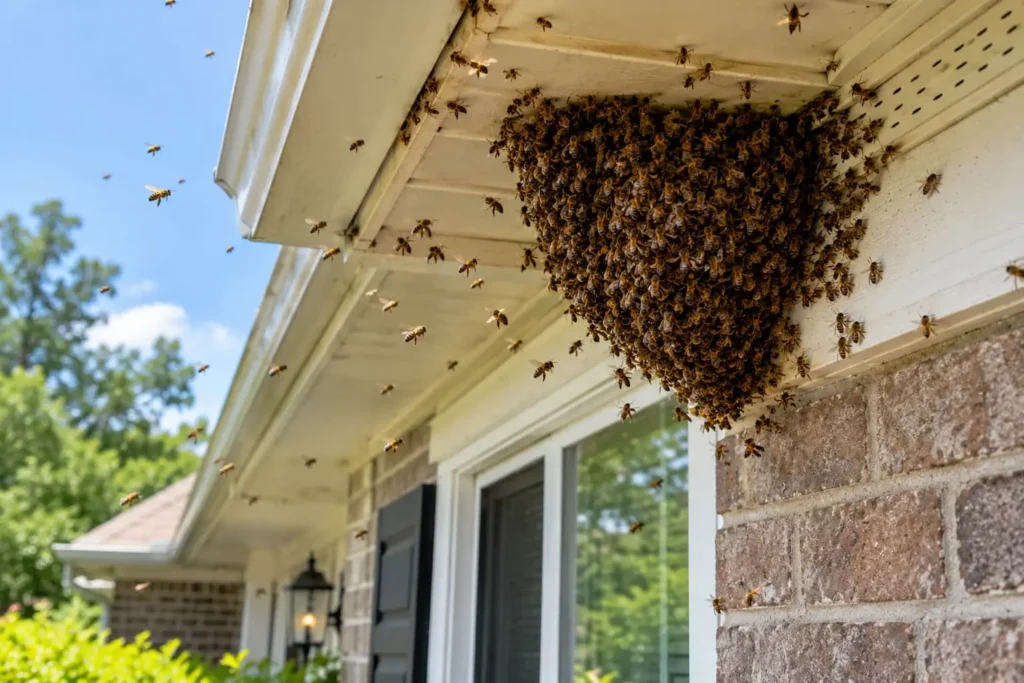
If bees repeatedly gather around roof eaves, soffits, fascia boards, attic vents, or gaps near the chimney, they may be investigating a sheltered cavity.
Honey bees often seek enclosed spaces that protect their colonies from weather and disturbance. Roof cavities, wall voids, and gaps around building features can provide suitable shelter.
A swarm may temporarily cluster near your roof while scout bees evaluate possible nesting locations.
Watch for these warning signs:
- Bees repeatedly entering and leaving the same small opening.
- Increasing bee activity around one section of the roof.
- Persistent buzzing inside a wall or ceiling.
- Bees emerging from a gap beneath the eaves.
- Activity that continues for several days rather than gradually disappearing.
A few bees passing your roof do not necessarily mean you have a hive. However, consistent traffic through the same opening deserves attention.
Important: Do not climb onto your roof, block the opening, or spray insecticide into the cavity. Disturbing an active colony can provoke defensive behavior, and sealing an entrance without addressing the colony may create additional problems.
If you suspect nesting inside your home, arrange a professional inspection.
4. A Honey Bee Swarm May Have Stopped Near Your Home
A bee swarm can look alarming because hundreds or thousands of bees may gather in a dense cluster on a tree branch, fence, shrub, or part of a building.
Swarming is a natural part of honey bee reproduction. When a colony divides, a queen and a large group of worker bees leave the original hive to establish a new colony.
The swarm may temporarily settle while scout bees search for a suitable nesting location.
Unlike bees that are actively defending an established hive, resting honey bee swarms are often relatively docile. Nevertheless, they should not be approached or disturbed.
What to do if you see a bee swarm near your home:
- Keep children, pets, and visitors away from the cluster.
- Do not spray the bees, throw objects at them, or attempt to move them.
- Avoid mowing, trimming branches, or performing noisy work close to the swarm.
- If the cluster is safely away from people and entrances, monitor it from a distance.
- Contact a qualified local beekeeper or professional bee removal service if the swarm is near a doorway, walkway, or other high-traffic area.
Some swarms relocate within hours or a few days, but this is not guaranteed. A swarm that settles near your home may choose a permanent nesting site.
Learn more about professional bee control services if the activity creates a safety concern or appears to be developing into a colony.
5. Bees May Already Be Living Inside a Wall or Attic
One of the most important reasons to investigate recurring bee activity is the possibility of an established hive inside your home.
Honey bees can establish colonies inside wall cavities, attics, roof spaces, chimneys, and other enclosed areas.
You may not see the hive itself. Instead, you might notice bees flying through a small exterior opening throughout the day.
Other warning signs include:
- A steady stream of bees entering and exiting one location.
- A persistent humming sound inside a wall or ceiling.
- Bee activity that continues for weeks.
- Honey or wax appearing near an opening or inside a cavity.
- New bees emerging around the same structural area.
An established colony may remain active long after the initial swarm has disappeared.
Leaving a colony inside a building can also create problems if it dies or is removed improperly. Honey and wax left behind may attract other insects, produce odors, and stain interior surfaces.
The safest next step is to have the suspected nesting area inspected. A qualified professional can determine whether a colony is present and recommend an appropriate removal method.
6. Carpenter Bees May Be Nesting in Wooden Roof Eaves
Not every bee gathering around your roof is a honey bee.
Carpenter bees can hover around wooden decks, fences, fascia boards, siding, and roof eaves. Unlike honey bees, which commonly nest in enclosed cavities, carpenter bees excavate tunnels in wood to create nesting galleries.
Signs of carpenter bee activity include:
- Round holes in exposed wooden surfaces.
- Bees repeatedly hovering near the same piece of wood.
- Sawdust-like material beneath a suspected nesting hole.
- Yellowish staining near an entrance hole from bee waste.
Carpenter bees do not eat wood, but repeated nesting can damage vulnerable wooden structures over time.
What to do: Inspect accessible wooden surfaces from a safe position and note where the bees are entering. Avoid sealing active holes before confirming that the nesting activity has been addressed.
Professional identification matters because carpenter bee control differs from honey bee swarm or hive removal.
How to Tell Whether Bees Are Just Visiting or Nesting
Use this quick comparison to decide whether further investigation is needed.
| What you notice | Possible explanation | Recommended action |
| A few bees visiting flowers | Normal foraging | Leave them undisturbed |
| Bees repeatedly visiting a birdbath or pool | Water collection | Address unnecessary water sources |
| A large cluster on a tree branch | Temporary honey bee swarm | Keep your distance and monitor safely |
| Bees repeatedly entering a roof gap | Possible established colony | Arrange a professional inspection |
| Bees hovering around round holes in wood | Possible carpenter bee nesting | Inspect the wood and seek appropriate treatment |
| Continuous buzzing inside a wall | Possible hidden colony | Avoid opening the wall and request an inspection |
These observations can help narrow down the cause, but appearance and behavior alone may not confirm the exact species.
How to Keep Bees From Gathering Around Your House
You cannot—and should not try to—eliminate every bee visiting your property. However, you can reduce avoidable nesting opportunities and address activity in problematic locations.
Seal Suitable Entry Points After Checking for Active Colonies
Inspect exterior walls, roof eaves, fascia boards, and gaps around utility penetrations.
Repair damaged building materials and seal appropriate openings once you are confident that no active colony is inside. Do not block a hole that bees are actively using before a professional has assessed the situation.
Keep Outdoor Areas Clean
Pick up fallen fruit, clean sugary spills, cover outdoor food, and keep rubbish containers closed.
These steps can reduce some food-related attractions, although they will not eliminate normal flower visitation or resolve an established hive.
Maintain Roofs, Eaves, and Wooden Structures
Schedule appropriate maintenance for damaged fascia boards, deteriorating wood, loose exterior panels, and gaps around roof features.
Check for recurring bee activity during routine exterior inspections, particularly during warmer months when bee activity may increase.
Avoid Unnecessary Pesticide Use
Do not assume that spraying visible bees will solve the problem.
Contact sprays may kill exposed insects without addressing a hidden colony. Improper treatment can also expose people and pets to pesticides and harm beneficial pollinators.
If you suspect a hive or persistent nesting activity, professional identification and a suitable treatment or removal plan are preferable to repeated DIY spraying.
For additional prevention advice, read our guide to pest prevention that protects your property.
When Should You Call a Professional for Bee Control?
Occasional bees visiting flowers generally do not require pest control. However, professional assistance is appropriate when bee activity creates a safety concern or suggests a colony is nesting in or around your home.
Consider requesting an inspection if:
- Bees repeatedly enter a roof, wall, attic, or chimney opening.
- A swarm settles close to your front door, patio, or walkway.
- You hear buzzing inside a wall or ceiling.
- Carpenter bees are repeatedly boring into wooden structures.
- The activity continues despite removing obvious food or water sources.
- Someone on your property has a known severe allergy to bee stings.
Do not attempt to remove a hive yourself, particularly from a roof, wall cavity, or other difficult-to-access location.
Honey bee swarms may be suitable for relocation by a qualified beekeeper, while established colonies inside structures may require specialist removal. Carpenter bees and wasps require different approaches, so identifying the insect is an important first step.
If you live in Los Angeles County or Orange County, Impressive Exterminating Pest Control offers professional bee control and inspection services.
The appropriate solution depends on the species, the location of the colony, the level of activity, and the conditions around your property.
For other insect concerns, explore our general pest control options.
Frequently Asked Questions
Why are bees gathering around my house all of a sudden?
Sudden bee activity may result from flowering plants, a nearby water source, or a honey bee colony beginning to swarm. If many bees cluster in one place or repeatedly enter the same roof or wall opening, a nesting site may be nearby.
Observe their behavior from a safe distance before deciding what action is necessary.
Why are bees hovering around my roof but not going away?
Bees may be investigating a sheltered cavity, searching for a nesting site, or entering an existing hive. If you repeatedly see bees flying into the same gap beneath your roof eaves, arrange an inspection rather than attempting to block the opening.
How long will a bee swarm stay near my house?
A resting honey bee swarm may move on within hours or a few days, but there is no guarantee. If the bees select a suitable nesting location and establish a colony, they may remain much longer.
Do not disturb the swarm to make it leave.
Does a bee swarm near my home mean there is a hive inside my house?
Not necessarily. A swarm may simply be resting on a tree, fence, or exterior surface while scout bees search for a new home. However, repeated movement into a roof or wall opening may indicate that the bees have selected a nesting site.
Why are bees gathering around my front door?
Bees may be attracted to nearby flowering plants, water, or sugary spills. They may also be investigating a sheltered gap around the doorframe or nearby wall.
Identify where the bees are concentrating. If they repeatedly enter a structural opening, request an inspection rather than spraying the area.
Should I spray bees that gather around my house?
No. Spraying a swarm or an unidentified group of bees can provoke defensive behavior and may harm beneficial pollinators. It may also leave an established colony inside a wall or roof untreated.
Keep your distance and contact a qualified beekeeper or professional bee control provider when removal is necessary.
Can bees damage my roof or walls?
Honey bees do not typically chew through structural wood to create their nests, but colonies established inside building cavities can leave behind honey, wax, and debris. These materials may cause staining, odors, and secondary pest problems if a colony dies or is removed improperly.
Carpenter bees can excavate nesting tunnels in exposed wood, potentially causing repeated damage.
Are bees around my house dangerous?
Many bees are not aggressive when left undisturbed, but they can sting when threatened or when defending a colony. The risk increases when a nest is near a frequently used entrance, walkway, or play area.
People with severe bee-sting allergies should take particular care. Keep children and pets away from swarms and suspected nesting sites.
When should I call a bee removal service in Los Angeles or Orange County?
Contact a professional if you see a large swarm near a high-traffic area, repeated bee activity at a roof or wall opening, buzzing inside a structure, or signs of carpenter bee nesting in wooden features.
A professional inspection can help identify the insect, determine whether a colony is present, and establish an appropriate removal or prevention plan.
Protect Your Home From Unwanted Bee Activity
Bees gathering around your house are not always a sign of an infestation. They may simply be visiting flowers or collecting water. However, persistent activity around roof eaves, wall openings, or other sheltered areas can indicate that a colony is establishing itself.
The important thing is to recognize the difference and respond safely. Avoid disturbing swarms, spraying unidentified insects, or sealing openings that may contain an active colony.
If you are noticing repeated bee activity around your roof, walls, or outdoor living areas, Impressive Exterminating Pest Control can help you determine the next step.
Our team serves homeowners throughout Los Angeles County and Orange County, including Long Beach, Pasadena, Anaheim, Irvine, and surrounding communities.
Request a professional bee control inspection to assess the activity around your property and discuss suitable treatment or removal options.