A few ants in the kitchen or a spider in the garage usually do not mean your home needs to be tented. But if pests are deeply established inside walls, wood, furniture, or multiple rooms, the question changes fast: when do you need fumigation for pests, and when is a more targeted treatment enough?
For homeowners, landlords, and business owners in Los Angeles County and Orange County, that answer depends on the pest, the scale of the infestation, and how far it has spread through the structure. Fumigation is one of the most effective tools in professional pest control, but it is not the first option for every pest problem. The right approach is the one that solves the issue completely while protecting your property, your time, and the people who use the space.
When do you need fumigation for pests?
You typically need fumigation when pests are hidden deep inside a structure and cannot be reliably eliminated with localized treatments. This is most common with severe drywood termite infestations, widespread bed bug activity in certain settings, and stored product pests that have spread throughout enclosed areas.
What makes fumigation different is reach. Instead of treating one wall void, one piece of wood, or one room, fumigation allows a treatment to penetrate the entire enclosed space. That matters when the infestation is not fully visible and when missing even a small pocket of activity means the problem will come back.
A professional inspection is what separates a necessary fumigation from an unnecessary one. If the infestation is isolated, there may be faster, less disruptive options. If it is widespread, deeply embedded, or recurring after spot treatments, fumigation often becomes the most dependable solution.
The pests that most often call for fumigation
In Southern California, drywood termites are the biggest reason a property owner is advised to fumigate. Unlike subterranean termites, drywood termites live directly inside the wood they consume. They do not need soil contact, which means they can establish colonies in framing, attics, trim, fascia boards, and other areas that are difficult to access.
If termite activity is limited to one clearly identified area, a localized wood treatment may work. But if inspection findings show termite evidence in several parts of the structure, or if there are signs the infestation has been active for a long time, fumigation is often the most effective path. It treats the whole structure at once, including hidden galleries you cannot see from the outside.
Bed bugs can also lead to fumigation in some cases, though not every bed bug problem requires it. Many bed bug infestations are handled successfully with room-by-room treatments, heat, follow-up service, and monitoring. Fumigation becomes more relevant when the infestation is severe, spread across multiple units or rooms, or tied to sensitive environments where complete elimination is critical.
Stored product pests are another category. In commercial settings such as food storage, warehouses, and certain retail or processing spaces, insects can spread widely through inventory and hidden cracks. If the contamination is broad and recurring, fumigation may be recommended to clear the infestation thoroughly.
Signs fumigation may be the right choice
The strongest sign is scope. If pests are showing up in multiple rooms, multiple areas of the structure, or in places that suggest hidden nesting or feeding, a surface treatment may not reach the core of the problem.
With drywood termites, warning signs include piles of pellet-like droppings, blistering or damaged wood, discarded wings near windowsills, and repeated evidence of activity in more than one section of the home or building. A history of prior spot treatments that did not fully resolve the issue is another major clue.
With bed bugs, the concern is spread and persistence. If activity continues after prior treatment attempts, if neighboring units are involved, or if the infestation has moved beyond a single sleeping area, the treatment plan needs to become more aggressive.
In commercial properties, fumigation becomes more likely when operations are being affected, tenants are complaining, inventory is at risk, or health and sanitation standards are on the line. In those cases, speed matters, but so does doing the job completely the first time.
When fumigation is probably not necessary
A lot of pest problems sound serious before they actually require whole-structure treatment. Roaches, ants, spiders, rodents, wasps, and mosquitoes are usually managed with targeted pest control methods, exclusion work, sanitation improvements, baiting, trapping, monitoring, and recurring service.
Even with termites, not every case calls for fumigation. If inspection shows a very limited drywood termite presence in one accessible area, a localized treatment may solve it with less preparation and less disruption. The trade-off is that spot treatment only addresses known areas. Fumigation addresses both known and hidden activity.
That is why honest inspection matters. Recommending fumigation for a problem that can be handled another way costs the customer more time and money than necessary. On the other hand, avoiding fumigation when the infestation is truly widespread can lead to repeat treatments, continued damage, and more frustration.
What to expect if your property needs fumigation
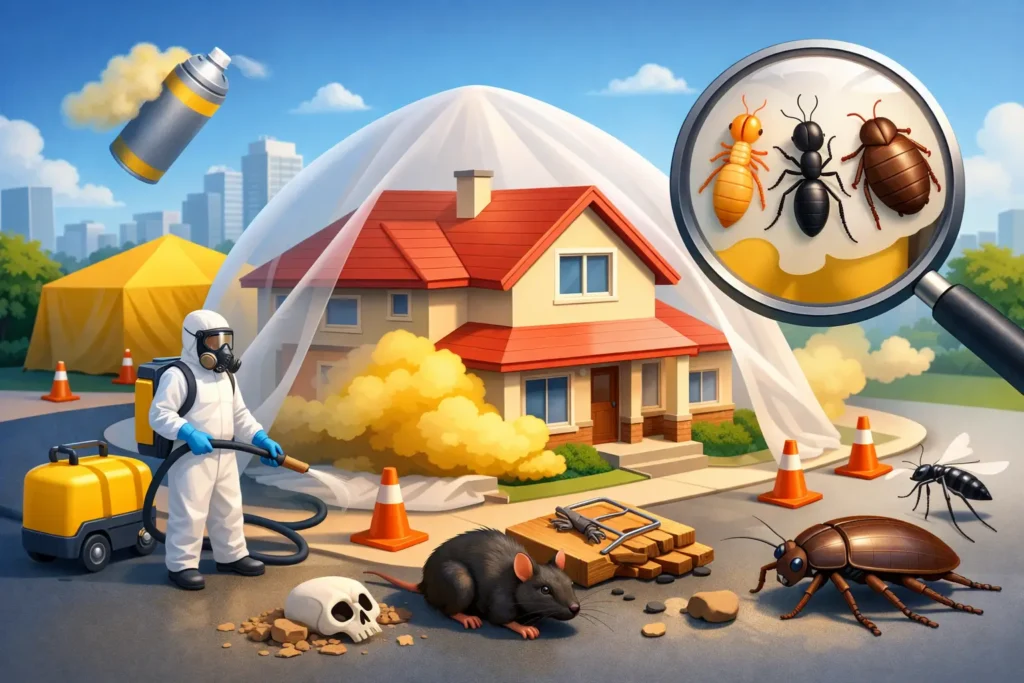
Fumigation is a structured process, not a guess. It starts with a detailed inspection and a clear explanation of why this method is being recommended. The property is then prepared and enclosed so the fumigant can reach all targeted areas. Occupants, pets, and plants must leave during the treatment period, and food, medicine, or other sensitive items may need to be bagged or removed based on the fumigation plan.
For many customers, this is the part that feels overwhelming. A good pest control company makes it manageable by giving exact preparation instructions, scheduling clearly, and explaining re-entry requirements. You should know what happens before service starts, how long the process will take, and when the home or business will be safe to enter again.
After treatment, the structure is aerated and cleared according to safety standards before reoccupation. For termite issues, fumigation eliminates the active infestation, but long-term protection may still require repairs, monitoring, and prevention steps to reduce future risk.
Why inspection matters more than assumptions
Online advice often pushes people toward extremes. Some assume fumigation is the only serious fix. Others avoid it at all costs because they hope a cheaper treatment will handle everything. In real pest control, the right answer is usually based on evidence, not guesswork.
A trained inspector looks at infestation type, spread, entry points, damage patterns, and the property itself. A single-family home in Long Beach may need a very different plan than a multi-unit rental in Orange County or a commercial building in Los Angeles. Construction type, occupancy, previous treatments, and the urgency of the problem all matter.
That local experience makes a difference. Pest pressures in Southern California are not theoretical. Drywood termites are common, multi-family properties create added complexity, and fast turnaround matters when tenants, customers, or family members are affected.
Choosing the right solution, not the biggest one
When people ask when do you need fumigation for pests, what they usually want to know is whether the problem can be solved fully without wasting time. That is the right question.
The best pest control plan is not the most dramatic one. It is the one that fits the infestation, protects the property, and prevents the issue from dragging on. Sometimes that means localized treatment and ongoing monitoring. Sometimes it means full fumigation because anything less would leave hidden pests behind.
At Impressive Exterminating, that decision starts with a thorough inspection and a practical recommendation based on what will actually work. If fumigation is necessary, you should be told clearly and prepared properly. If it is not, you should have a safer, effective alternative that gets results without extra disruption.
If you are seeing repeated signs of termites or another hard-to-reach infestation, do not wait for more damage or more spread. Getting the right diagnosis early can save money, reduce stress, and put you back in control of your home or business with confidence.