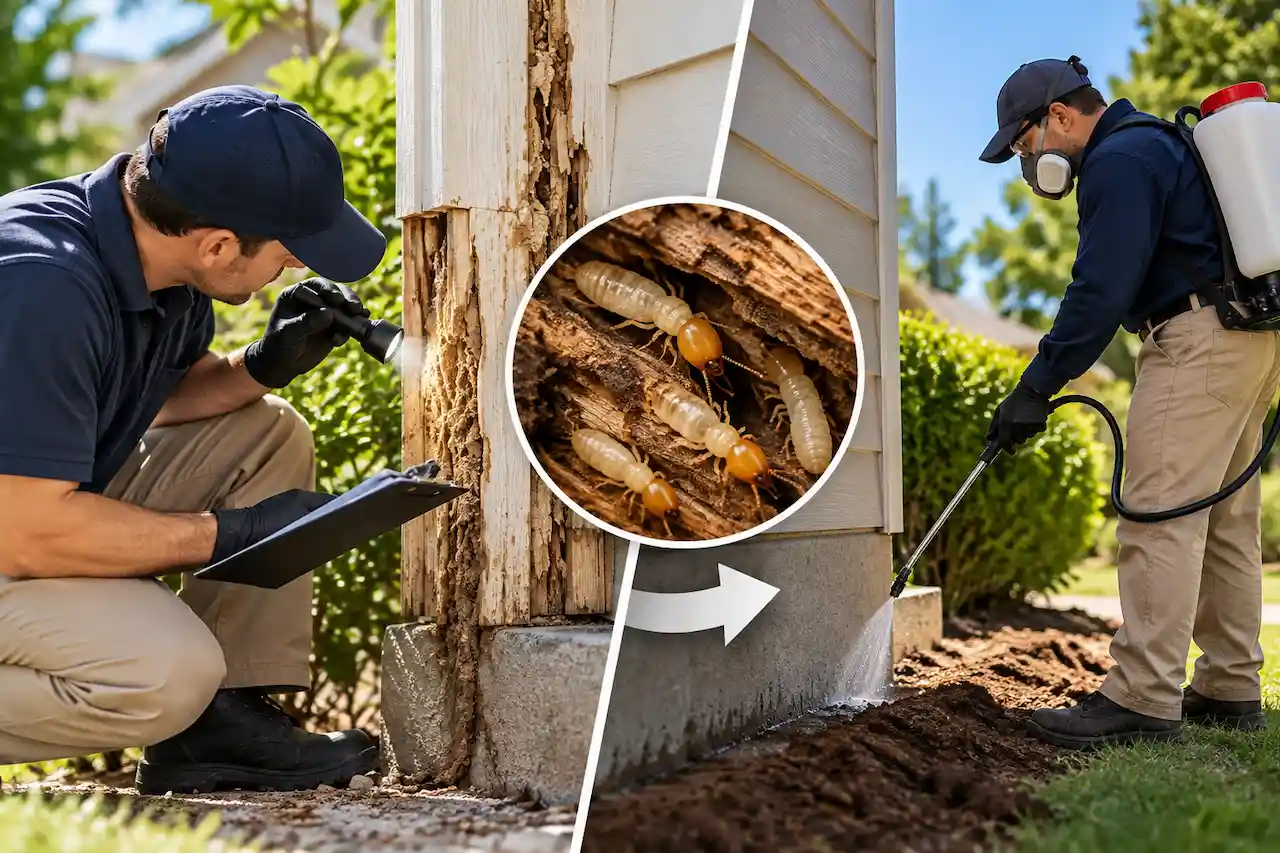
You discover a small pile of termite droppings near your window, notice mud tubes along the foundation, or find tiny wings scattered across the floor. Your first thought is probably: Do I need a termite inspection or immediate treatment?
The answer can determine how effectively you protect your property and how much you spend fixing the problem.
When comparing termite inspection vs treatment, the biggest difference is their purpose. A termite inspection identifies signs of infestation, evaluates accessible areas, and helps determine the appropriate next steps. Termite treatment targets an existing infestation or provides protection against future termite activity.
For most homeowners, an inspection should come first because treating termites without identifying the species, location, and extent of the problem can lead to unnecessary expenses or incomplete control.
This guide explains the differences between termite inspection and treatment, when each service is necessary, what costs to consider, and how homeowners in Los Angeles County and Orange County can make informed decisions.
Termite Inspection vs Treatment: Understanding the Difference
Although termite inspections and treatments work together, they serve different purposes.
A termite inspection determines whether there is evidence of termites, where the problem may be located, and what conditions could contribute to an infestation.
Termite treatment focuses on controlling or eliminating termite activity through methods appropriate for the species and property.
Here is a direct comparison.
| Feature | Termite Inspection | Termite Treatment |
| Primary purpose | Identify termite activity and damage | Control or eliminate termites |
| Main objective | Diagnose the problem | Address the infestation |
| When needed | When termites are suspected or as preventive maintenance | When treatment is justified by inspection findings |
| Typical process | Visual examination, probing, moisture assessment, documentation | Localized treatment, baiting, soil treatment, or fumigation |
| Time required | Often 30–90 minutes for a typical home | Varies from a localized service to a multi-day process |
| Cost | May be free or involve an inspection fee | Depends on species, severity, method, and property size |
| Main outcome | Findings and recommendations | Termite control and potential protection |
| Follow-up | Monitoring or further investigation | Verification, monitoring, and prevention |
The key takeaway: A termite inspection tells you what is happening. Termite treatment addresses the problem identified.
Importantly, not every termite inspection results in a treatment recommendation.
Why Should a Termite Inspection Come Before Treatment?
Imagine finding termite droppings near a wooden window frame.
You might assume the entire house needs fumigation. However, an inspection could reveal a localized drywood termite infestation that may be suitable for targeted treatment.
Alternatively, a small amount of visible evidence could indicate activity in several inaccessible areas, making a more comprehensive approach worth considering.
Without an inspection, neither conclusion is reliable.
Understanding termite inspection vs treatment helps homeowners avoid unnecessary expenses and choose the right solution. A professional inspection identifies termite activity, determines the species, and evaluates the affected areas before recommending an appropriate treatment method.
1. Identify the Correct Termite Species
Southern California properties can experience several types of termites, particularly drywood and subterranean termites.
These species behave differently.
Drywood termites establish colonies inside wood and do not require contact with soil. They may infest attic framing, window trim, doors, furniture, and other wooden components.
Subterranean termites generally nest in soil and travel through protected pathways to reach wood and other cellulose-containing materials.
A treatment designed for subterranean termites may not adequately address drywood termites living inside attic framing.
Correct identification is therefore essential.
2. Determine Whether the Infestation Is Active
Finding termite damage does not automatically mean termites are still present.
An inspector may discover:
- Evidence of active termite feeding.
- Damage from a previous infestation.
- Termite droppings without visible live termites.
- Conditions that increase future infestation risk.
- Signs requiring further investigation.
Distinguishing old damage from current activity helps prevent unnecessary treatment.
However, the absence of visible termites does not conclusively rule out hidden activity.
3. Understand the Extent of the Problem
Termites often remain concealed inside wooden structures.
A small visible sign may represent a localized issue or part of a more extensive infestation.
A professional inspection helps evaluate accessible areas and identify evidence that may justify additional investigation.
This is particularly important for older homes, properties with crawl spaces, and buildings with previous termite damage.
4. Avoid Paying for the Wrong Treatment
Termite treatments differ in price, preparation requirements, and effectiveness against particular infestations.
Choosing a method without sufficient evidence may result in unnecessary expense.
For example, whole-structure fumigation may be excessive for a limited, accessible drywood termite infestation. Conversely, localized treatment may be inadequate when activity is widespread.
The goal is not simply to select the cheapest treatment.
It is to choose an appropriate solution for the actual infestation.
What Happens During a Professional Termite Inspection?
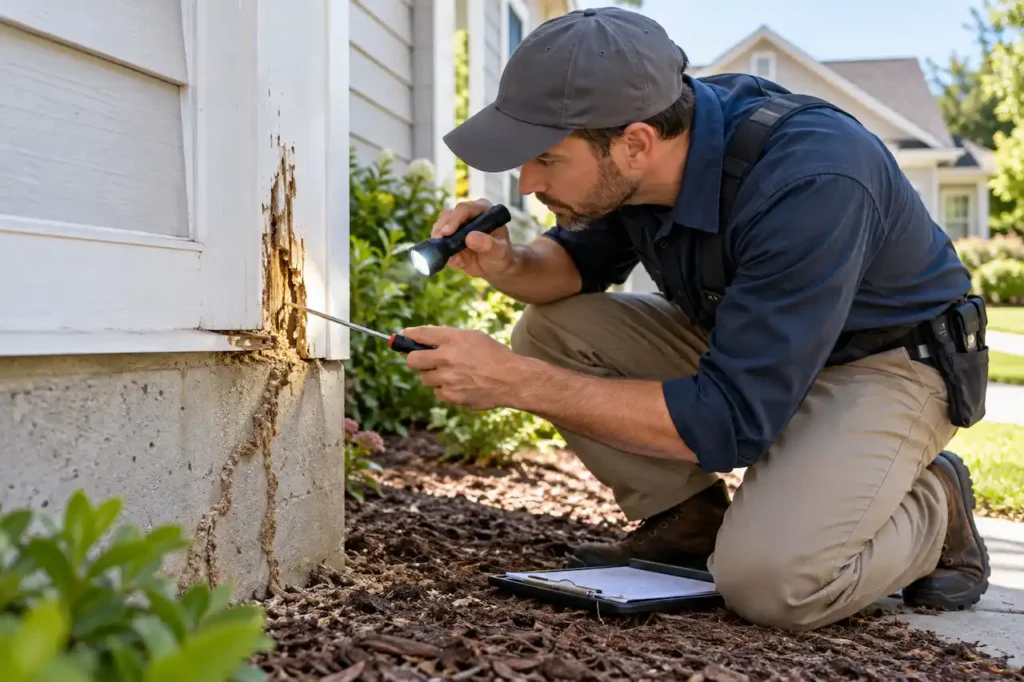
A professional termite inspection involves examining accessible areas where termites commonly enter, travel, feed, or establish colonies.
The inspector evaluates visible evidence, structural conditions, and potential risk factors.
When considering termite inspection vs treatment, the inspection process is the essential first step. A qualified technician checks accessible wooden structures, foundations, and other vulnerable areas for signs of termite activity. These findings help determine whether immediate treatment, additional investigation, or preventive monitoring is necessary.
Step 1: Exterior Property Examination
The inspection may begin around the exterior of the building.
Common inspection areas include:
- Foundations and exterior walls.
- Wooden siding and trim.
- Decks, fences, and attached wooden structures.
- Areas where wood contacts soil.
- Landscaping near the foundation.
- Plumbing penetrations and utility entry points.
The inspector looks for mud tubes, damaged wood, moisture problems, and other evidence of termite activity.
Step 2: Interior Inspection
Inside the property, accessible areas may include:
- Window and door frames.
- Baseboards and wooden trim.
- Cabinets and flooring edges.
- Attics and crawl spaces.
- Garages and storage areas.
- Areas around plumbing leaks.
Inspectors may use probing tools, moisture meters, or other equipment when appropriate.
However, a standard visual inspection cannot guarantee detection of termites hidden behind every wall or inaccessible surface.
Step 3: Evaluate Termite Warning Signs
Some of the most common warning signs include:
Mud tubes: Narrow, soil-like tunnels often associated with subterranean termites.
Termite droppings: Small, hard pellets commonly produced by drywood termites.
Discarded wings: Wings left behind by reproductive termites after swarming.
Damaged wood: Wood that appears hollow, weakened, or internally excavated.
Small exit holes: Openings through which drywood termites may expel pellets.
These signs help guide further investigation but do not independently establish the full extent of an infestation.
Step 4: Explain Findings and Recommend Next Steps
After examining the property, the inspector should explain:
- What evidence was discovered.
- Where termite activity or damage was identified.
- Whether the evidence suggests current or previous infestation.
- Which areas could not be fully inspected.
- Whether treatment is recommended.
- Which treatment methods may be appropriate.
- Whether repairs, moisture correction, or monitoring are needed.
For property transactions, a formal wood-destroying pest inspection report may be necessary.
Homeowners should ask for written findings and a clear explanation of any proposed treatment.
When Is Termite Treatment Actually Necessary?
Termite treatment is generally appropriate when an inspection identifies an active infestation or sufficient evidence of continuing termite activity.
However, the specific treatment depends on the findings.
Situation 1: Active Drywood Termites in One Accessible Area
If an infestation appears limited to an identifiable section of wood, localized treatment may be considered.
Depending on the situation, this could involve direct treatment of the affected area or replacement of infested wood.
The inspector must determine whether the infestation can be reliably located and addressed.
Situation 2: Widespread Drywood Termite Activity
When drywood termites are present in multiple areas or inaccessible structural components, whole-structure fumigation may be recommended.
Fumigation can reach termites in areas that localized applications cannot reliably access.
However, fumigation requires preparation and temporary vacancy, and it does not provide lasting protection against future infestations.
Situation 3: Subterranean Termites Entering Through the Foundation
Subterranean termite treatment may involve liquid soil treatments, baiting systems, or other approved methods.
The appropriate approach depends on the building’s construction, soil conditions, termite activity, and treatment objectives.
Situation 4: Old Damage Without Confirmed Current Activity
If an inspection identifies historical damage but no evidence sufficient to justify immediate treatment, monitoring and preventive maintenance may be recommended.
The inspector may suggest additional evaluation if important areas remain inaccessible.
Remember: Old termite damage does not disappear after termites are eliminated. Structural repairs may still be necessary.
Termite Treatment Options: Which Method Is Right for Your Home?
Not every termite infestation requires the same treatment.
Understanding the main options helps homeowners evaluate professional recommendations.
Localized Termite Treatment
Localized treatment focuses on specific infested areas.
It may be appropriate when drywood termite activity is limited and the affected wood can be identified and accessed.
Advantages:
- Targets a defined area.
- Usually requires less disruption than whole-structure fumigation.
- May involve less preparation.
- Can be suitable for smaller, accessible infestations.
Limitations:
- May not reach undiscovered colonies.
- Effectiveness depends on accurate identification of infested areas.
- Does not automatically protect the entire structure.
Whole-Structure Fumigation
Fumigation involves enclosing the structure and using a registered fumigant under professional supervision.
It is commonly considered for widespread drywood termite infestations.
Advantages:
- Can reach termites throughout enclosed structural spaces.
- Does not require locating every individual drywood termite gallery.
- Can address multiple drywood termite infestation sites during one treatment.
Limitations:
- Requires occupants to leave temporarily.
- Involves detailed preparation.
- Does not repair existing damage.
- Does not provide residual protection against future infestations.
Liquid Soil Termite Treatment
Liquid termiticides may be applied to soil around or beneath a structure according to the product label and treatment plan.
These treatments are primarily used against subterranean termites.
Their effectiveness and duration depend on the product, application, site conditions, and subsequent disturbance of treated soil.
Termite Baiting Systems
Termite baiting systems use strategically placed monitoring or bait stations.
When subterranean termites encounter and consume an appropriate bait, the active ingredient can affect the colony.
Bait systems require proper placement, ongoing monitoring, and maintenance.
They are not an instant solution and are not generally used to eliminate drywood termite colonies inside structural wood.
Wood Treatments
Certain wood treatments may be used on accessible, susceptible, or infested wooden components.
Their suitability depends on the product, application method, wood accessibility, and termite species.
A licensed termite professional can explain which methods are appropriate for your property.
For more information, explore our professional termite control services.
How Much Does a Termite Inspection vs Treatment Cost?
Cost is one of the most important considerations for homeowners deciding whether to schedule an inspection or proceed with treatment.
However, termite service prices vary considerably.
Termite Inspection Costs
Some pest control companies provide complimentary initial inspections, while others charge an inspection fee.
Pricing can depend on:
- Property size.
- Building accessibility.
- Inspection scope.
- Whether a formal written report is required.
- Real estate transaction requirements.
- Additional structures requiring evaluation.
Impressive Exterminating advertises free termite inspections through its termite-control service page. Homeowners should confirm what the complimentary inspection includes and whether specialized reports involve additional charges.
Termite Treatment Costs
Treatment costs depend on several factors.
Termite species: Drywood and subterranean termites may require different treatment methods.
Infestation severity: Widespread activity may require more extensive work.
Property size: Larger structures may involve more labor, materials, and preparation.
Treatment method: Localized treatment, soil treatment, baiting, and fumigation have different pricing structures.
Accessibility: Difficult-to-reach areas can increase the complexity of treatment.
Follow-up requirements: Monitoring, maintenance, and warranty coverage may affect the overall cost.
Instead of choosing a company solely based on the lowest estimate, request an explanation of the recommended method, treatment scope, limitations, and follow-up terms.
A lower initial price does not necessarily represent better value if significant termite activity remains untreated.
Can You Skip a Termite Inspection and Go Straight to Treatment?
In most situations, skipping the diagnostic process is not advisable.
Homeowners sometimes attempt DIY treatment after discovering termite wings, damaged wood, or droppings.
However, treating only the visible evidence may leave the underlying infestation unaffected.
For example, spraying termites emerging from a wooden frame does not necessarily reach the colony inside the structure.
Similarly, treating drywood termite activity with a product intended for soil-dwelling termites may fail to address the actual problem.
Another concern is misidentification.
Flying ants, wood-boring beetles, moisture damage, and old termite damage can sometimes be confused with current termite activity.
Professional evaluation reduces the likelihood of choosing an inappropriate treatment.
What if you already know termites are present?
You should still have a qualified professional assess the species, affected areas, and treatment requirements before work begins.
An inspection does not necessarily require a separate appointment. In some circumstances, the assessment and appropriate treatment may occur during the same service visit.
What Should You Do If You Find Termites Before an Inspection?
Discovering possible termite activity can be stressful, especially when you are unsure how much damage has already occurred.
The best approach is to preserve evidence and arrange a professional evaluation.
1. Document the Warning Signs
Take clear photographs of mud tubes, droppings, discarded wings, or damaged wood.
Record where and when you discovered them.
2. Avoid Disturbing Suspected Infested Areas
Do not immediately remove damaged wood, break apart suspected galleries, or apply random pesticides.
Disturbing evidence may make it harder to identify activity accurately.
3. Check for Moisture Problems
Look for leaking plumbing, poor drainage, and excessive moisture around the foundation.
Addressing moisture problems can reduce conditions favorable to certain termite species.
4. Schedule a Professional Inspection
Arrange an inspection promptly, particularly if you notice fresh mud tubes, repeated droppings, active swarmers, or weakened wood.
5. Request a Clear Treatment Explanation
Before approving work, ask the inspector to explain why the proposed method is appropriate.
You should understand what will be treated, what remains outside the treatment scope, and what follow-up is recommended.
If wood appears structurally unsafe, avoid placing weight on the affected area and arrange an appropriate structural evaluation.
Termite Inspection Before Buying or Selling a House in California
Termite inspections are particularly important during real estate transactions.
A property can appear well-maintained while containing hidden termite damage.
For buyers, an inspection can identify potential repair expenses before closing.
For sellers, understanding existing termite conditions can help address concerns during negotiations.
In California, licensed structural pest control operators perform wood-destroying pest inspections and prepare reports under applicable state requirements.
These reports may distinguish between visible evidence of infestation or damage and conditions considered likely to lead to future problems.
Depending on the transaction, buyers and sellers may negotiate responsibility for treatment, repairs, and inspection expenses.
A termite inspection is not automatically required for every California property sale. Requirements depend on the transaction, lender, contract, and other applicable conditions.
If you are buying or selling property in Los Angeles or Orange County, confirm the necessary inspection and documentation requirements before closing.
How Often Should You Schedule a Termite Inspection?
There is no single inspection schedule appropriate for every property.
Many homeowners consider annual termite inspections, particularly when their properties have elevated risk factors.
More frequent evaluation may be appropriate when recommended by a licensed professional.
Properties that may benefit from closer monitoring include:
- Older homes with extensive wooden construction.
- Buildings with previous termite infestations.
- Homes with crawl spaces.
- Properties with recurring plumbing leaks.
- Structures with wood-to-soil contact.
- Buildings surrounded by irrigated landscaping.
- Rental properties with recurring maintenance concerns.
Regular inspections cannot guarantee that termites will never enter a property.
However, they can help identify warning signs before damage becomes more extensive.
For additional prevention guidance, read our 7 Best Termite Prevention Methods for Homes.
Termite Inspection vs Treatment in Los Angeles and Orange County
Southern California homeowners face termite risks influenced by local climate, building design, moisture conditions, and surrounding landscaping.
Drywood termites can infest wooden components above ground, while subterranean termites may enter buildings through soil-connected pathways.
This makes species identification especially important.
A treatment approach suitable for drywood termites in an attic may not address subterranean termite activity beneath a foundation.
Homes with older wooden framing, attached decks, crawl spaces, and previous moisture damage may require particularly careful evaluation.
For landlords and property managers, termite inspections can also support maintenance planning and reduce unexpected disruption to tenants.
Impressive Exterminating Pest Control serves residential and commercial customers across Los Angeles County and Orange County.
Our approach begins with understanding the termite problem and recommending an appropriate response based on the property’s conditions.
Whether you are dealing with suspicious droppings, termite swarmers, or damaged wood, an inspection helps determine the next step.
How to Choose a Reliable Termite Inspection and Treatment Company
Choosing a termite company should involve more than comparing prices.
Before approving treatment, consider the following questions.
Is the company properly licensed?
California termite inspection and treatment work is regulated. Verify that the provider holds the appropriate structural pest control licensing.
Will the inspector explain the findings?
You should understand where evidence was found and whether the infestation appears active.
Does the treatment match the termite species?
Ask why the recommended method is suitable for the identified termites.
Are alternative treatments available?
For certain infestations, more than one treatment approach may be appropriate.
What does the warranty cover?
Clarify whether the agreement includes retreatment, monitoring, repairs, or specific exclusions.
Will follow-up inspections be necessary?
Some treatments require monitoring or additional evaluation.
Are structural repairs included?
Termite treatment and damage repair are separate services unless the contract explicitly includes both.
A dependable provider should be able to answer these questions without pressuring you into unnecessary treatment.
What Happens After Termite Treatment?
Successful termite management does not necessarily end when the initial treatment is completed.
Depending on the method, follow-up may include:
- Inspecting previously affected areas.
- Monitoring termite bait stations.
- Checking for new mud tubes or droppings.
- Evaluating whether additional treatment is necessary.
- Correcting moisture or wood-contact conditions.
- Reviewing warranty and retreatment terms.
Homeowners should also understand that termite treatment does not automatically restore damaged wood.
If structural components have been weakened, qualified repair professionals may need to evaluate and replace affected materials.
Long-term protection involves both termite control and appropriate property maintenance.
Frequently Asked Questions About Termite Inspection vs Treatment
1. What is the main difference between termite inspection and treatment?
A termite inspection identifies evidence of termites, evaluates accessible damage, and helps determine whether treatment is necessary. Termite treatment uses appropriate control methods to address an infestation or protect vulnerable areas. Inspection is the diagnostic step, while treatment is the corrective step.
2. Should I get a termite inspection before treatment?
Yes, in most cases. A professional inspection helps identify the termite species, affected areas, and extent of activity before selecting a treatment method. This reduces the risk of unnecessary or ineffective treatment.
3. Can a termite inspection find termites inside walls?
An inspection may identify evidence suggesting termites are present inside walls, but a standard visual inspection cannot examine every concealed space. Additional investigative methods may be recommended when hidden activity is suspected.
4. Does every termite inspection lead to treatment?
No. An inspection may reveal old damage, preventive maintenance concerns, or no evidence sufficient to justify immediate treatment. The inspector may recommend monitoring, repairs, moisture correction, or further investigation instead.
5. How long does a termite inspection take?
A typical residential termite inspection may take approximately 30–90 minutes, although larger properties, difficult access, or more extensive findings can require additional time.
6. Is termite fumigation better than localized treatment?
Neither method is universally better. Localized treatment may be suitable for limited, accessible drywood termite infestations. Whole-structure fumigation may be more appropriate when drywood termite activity is widespread or difficult to access. The inspection findings should guide the decision.
7. Can termites return after treatment?
Yes. Future infestations are possible, even after successful treatment. The likelihood depends on the termite species, treatment method, environmental conditions, and whether new colonies gain access to the property. Monitoring and prevention remain important.
8. What if I find termite droppings but no live termites?
Termite droppings can indicate previous or ongoing drywood termite activity. Because termites often remain hidden inside wood, not seeing live insects does not confirm that an infestation has ended. A professional inspection can help determine whether further investigation or treatment is needed.
9. Is a termite inspection necessary for a newly built home?
New construction can still be vulnerable to termites. Preventive construction practices and any existing treatment warranties should be reviewed, and inspections may be appropriate based on the building’s conditions and termite risk.
10. Does homeowners insurance cover termite treatment?
Most standard homeowners insurance policies generally exclude termite damage and routine pest treatment because they are considered maintenance-related concerns. However, coverage depends on the specific policy and circumstances. Review your policy or contact your insurer for clarification.
11. Can I stay home during termite treatment?
It depends on the treatment method. Some localized treatments may allow occupants to remain on the property subject to product instructions and technician guidance. Whole-structure fumigation requires occupants and pets to leave until the structure has been cleared for reentry.
12. How soon should I schedule treatment after termites are discovered?
Arrange a professional inspection promptly after finding credible signs of termite activity. If treatment is recommended, schedule it according to the infestation’s severity, structural concerns, and the professional’s assessment. Delaying confirmed active infestations can allow additional damage.