Finding ants in your kitchen, cockroaches in your bathroom, or mosquitoes around your backyard can be frustrating. But if you have a crawling baby, curious toddler, or beloved family pet, calling an exterminator may raise another concern: Is pest control safe for pets and children?
It is a reasonable question. You want to eliminate pests without exposing your family to unnecessary pesticide risks.
The good news is that professional pest control can be performed with precautions designed to reduce exposure to children and animals. The important factors are the products used, how they are applied, where treatment takes place, and whether you follow the technician’s safety instructions.
For families across Los Angeles County and Orange County, understanding these precautions can help you make informed decisions about protecting your home.
At Impressive Exterminating Pest Control, we provide pest management solutions for common household problems, including ants, rodents, bed bugs, termites, mosquitoes, and spiders. Our goal is to help families address pest problems while considering the safety of people, pets, and the surrounding environment.
Is Pest Control Safe for Pets?
Yes, pest control can be compatible with homes that have pets, provided the products are appropriate for the situation and all label instructions and safety precautions are followed. However, no pesticide should automatically be considered harmless to every animal.
A product’s risk depends on its active ingredients, concentration, application method, amount of exposure, and the animal’s species, size, and health.
Dogs, cats, birds, fish, rabbits, and other pets can respond differently to pesticide exposure. Cats, for example, may be especially vulnerable to certain insecticides, while aquatic animals can be highly sensitive to chemicals that enter aquarium water.
That is why pet owners should tell their pest control provider which animals live in the home before treatment begins.
How to Protect Pets Before Pest Control Treatment
Take these steps before your appointment:
- Remove pets from treatment areas: Keep dogs, cats, and other animals away from the areas being treated.
- Protect food and water: Remove pet food bowls, water dishes, toys, bedding, and litter boxes from the treatment area.
- Secure aquariums: Tell your technician about fish tanks and other aquatic habitats. Follow product-specific instructions for protecting them, including any requirements involving tank covers or filtration.
- Ask about the pesticide: Request the product name, active ingredients, application method, and relevant safety information.
- Confirm when pets can return: Follow the product label and your technician’s specific re-entry instructions. Do not assume that every treatment has the same waiting period.
- Keep pets away from bait stations: Ensure baits and other pesticide products remain inaccessible to animals.
The U.S. Environmental Protection Agency recommends following pesticide labels and keeping pets away from treated areas as directed.
If you have a cat, a bird, or an animal with a medical condition, discuss that circumstance with your pest control provider before the appointment.
Is Pest Control Safe for Babies and Toddlers?
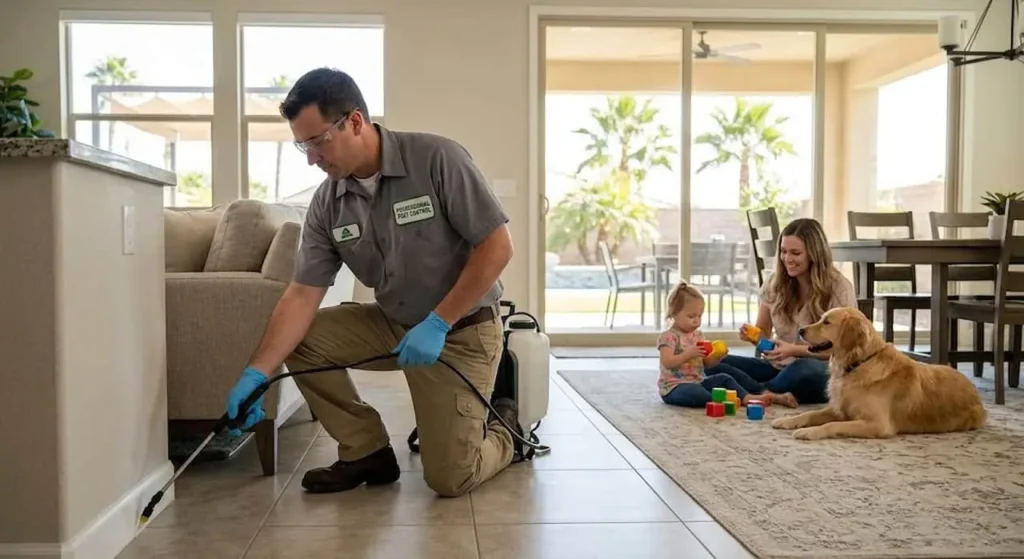
Professional pest control can be carried out with precautions that reduce children’s exposure, but the treatment must be selected and applied appropriately.
Babies and toddlers need particular consideration because they spend time close to floors, crawl across surfaces, touch objects, and frequently put their hands or toys in their mouths.
Even when a product is intended for residential use, improper application or contact with a wet treatment can create avoidable exposure.
Why Crawling Babies Need Extra Protection
A crawling baby may come into contact with surfaces that adults rarely touch directly. Baseboards, floor edges, cracks, and spaces beneath furniture can be particularly relevant if they are treatment areas.
Parents should take these precautions:
- Move babies and toddlers away from rooms during treatment.
- Remove bottles, pacifiers, blankets, toys, and other items that could contact treated surfaces.
- Follow all instructions about ventilation and when to re-enter the home.
- Keep children away from treated areas for the period specified by the product label and technician.
- Do not allow children to touch treated surfaces until the applicable instructions permit contact.
- Store household pesticides in their original containers, securely out of children’s reach.
Important: There is no universal rule that every home is safe to re-enter after two hours, once the spray dries, or after spending a night elsewhere. The correct precautions depend on the product and application. Follow the specific instructions provided for your treatment.
If your child has asthma, significant allergies, or another health concern, discuss it with your pediatrician and inform your pest control provider before treatment.
Is Pest Control Safe for Older Children?
Older children can also be exposed to pesticides if they touch treated surfaces, handle bait stations, or play in recently treated yards.
The solution is not necessarily to avoid pest control altogether. Instead, choose an appropriate treatment and make sure children understand the safety boundaries.
Before the appointment:
- Tell the technician which rooms your children use most frequently.
- Remove toys, sports equipment, and outdoor play items from treatment areas.
- Ask whether treatment can be concentrated in cracks, crevices, or other targeted locations rather than applying products broadly.
- Find out whether your children need to stay away from the yard, patio, or playground after an outdoor application.
- Keep all pesticide containers and bait stations inaccessible to children.
After treatment, follow the technician’s instructions before allowing children to resume normal activities.
If you are treating an outdoor play area, ask specifically whether the product is approved for the intended application and what restrictions apply to treated vegetation, grass, or other surfaces.
Which Pest Control Treatments May Be Appropriate for Homes With Pets and Children?
Not every infestation requires the same approach. A treatment that works well for ants may not be suitable for a termite infestation or a bed bug problem.
The best approach starts with identifying the pest and understanding where it lives.
1. Bait Stations for Certain Ant and Cockroach Problems
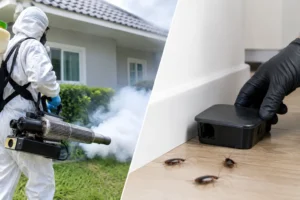
Where appropriate, professionally placed bait stations can reduce the need for widespread spraying.
The bait attracts the target pest, which consumes or carries the material back to its colony, depending on the product and pest species.
However, bait stations are not automatically harmless. Children and pets must not be able to open, chew, move, or otherwise access them.
Ask your technician whether a bait-based treatment is appropriate for the infestation and where the stations will be placed.
2. Targeted Crack-and-Crevice Treatments
Some pest problems can be managed by applying products to specific cracks, crevices, or hiding places.
Targeted applications may reduce unnecessary treatment of open surfaces when they are appropriate for the pest and product.
The exact application method depends on the infestation, product label, and site conditions.
3. Traps and Exclusion for Rodents
Rodent management does not always require the use of rodenticides.
Depending on the circumstances, a pest management plan may include traps, monitoring, sanitation, and sealing openings through which rodents enter the home.
If rodenticide is necessary, ask about the product and the measures used to prevent access by children and pets.
4. Heat Treatment for Certain Bed Bug Infestations
Heat treatment may be an option for bed bugs in suitable situations.
Properly conducted heat treatment can eliminate bed bugs without leaving pesticide residue from the heat application itself. However, preparation requirements, high temperatures, and the possibility of supplementary chemical treatment mean that the home must still be managed according to professional instructions.
Families should remove people and pets from the treatment area as directed and confirm when it is safe to return.
Explore our bed bug control services to learn more about professional treatment options.
How Long After Pest Control Is It Safe for Pets and Children?
There is no single waiting period that applies to every pesticide or treatment method.
Some applications require people and pets to stay away until treated surfaces are completely dry. Others may require a longer exclusion period or additional precautions. Certain specialized treatments require everyone to leave the building until the treatment and clearance procedures are complete.
The pesticide label and the technician’s instructions should determine when you can return.
Use this checklist before allowing your family back into treated areas:
| Safety question | What to do |
| Has the required waiting period passed? | Follow the product-specific instructions. |
| Are treated surfaces dry, if required? | Keep people and animals away until the stated conditions are met. |
| Does the treatment require ventilation? | Follow the instructions for ventilation and re-entry. |
| Were toys, food, or pet supplies exposed? | Ask the technician whether they need cleaning or replacement. |
| Were bait stations installed? | Confirm that children and pets cannot access them. |
| Was the yard treated? | Ask when pets and children may return to the treated outdoor areas. |
Do not rely on a generic online recommendation if your technician has provided different instructions for the actual product used.
.
What Should You Do Before an Exterminator Arrives?
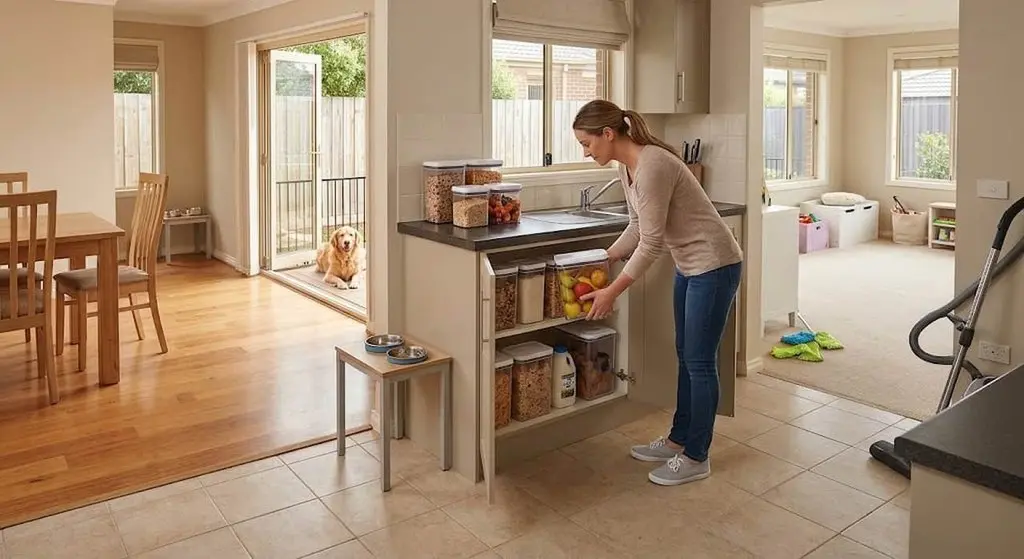
Preparing your home helps the technician work efficiently and reduces the chance of accidental exposure.
Before Indoor Treatment
1. Tell the company about your family and pets.
Mention babies, toddlers, children with allergies, dogs, cats, birds, fish, and any other animals in the home.
2. Ask what treatment will be used.
Request the product name, active ingredients, application locations, and required re-entry precautions.
3. Remove food and personal items.
Store food securely and move toys, pet bowls, bedding, and other personal items away from the treatment area as instructed.
4. Clear the affected areas.
Follow preparation instructions for cabinets, furniture, appliances, and storage spaces. Do not move potentially contaminated items into untreated rooms without asking your technician.
5. Arrange somewhere else to stay if necessary.
If the treatment requires you to leave, plan for children and pets to remain elsewhere for the entire specified period.
Before Outdoor Treatment
Southern California families often spend time in backyards, patios, gardens, and outdoor play areas.
Before outdoor pest control:
- Pick up pet toys, food bowls, and children’s outdoor toys.
- Tell the technician where children play and where pets usually rest.
- Identify vegetable gardens, edible plants, ponds, and aquariums near the treatment area.
- Ask whether windows and doors should remain closed during application.
- Confirm when the yard and treated vegetation can be used again.
For additional prevention, our guide to mosquito control after rain can help you identify standing water and other mosquito-breeding conditions around your property.
Are Natural or Organic Pest Control Products Safer for Pets?
Not necessarily.
A product described as natural, botanical, or organic can still cause harm if it is used incorrectly or if an animal is exposed to an unsuitable ingredient.
Essential oils and botanical insecticides are common examples. Some ingredients that people consider natural can be irritating or toxic to certain animals, especially when concentrated or applied improperly.
Instead of choosing a treatment based only on marketing terms, ask these questions:
- Is the product registered or otherwise authorized for the intended use?
- Is it suitable for the pest and application site?
- What does the label say about children and pets?
- How should the product be applied?
- What precautions are required before people and animals can return?
A well-selected, correctly applied treatment is more meaningful than a vague claim that a product is completely safe.
If you prefer to minimize pesticide use, tell your provider. Depending on the pest, an integrated pest management approach may combine inspection, sanitation, exclusion, monitoring, and carefully selected pesticide applications.
What If Your Pet or Child Comes Into Contact With Pest Control Products?
If you suspect exposure, take it seriously.
Do not assume that an animal or child will be fine simply because the product was used by a professional.
If a Child May Have Been Exposed
- Move the child away from the treated area.
- Follow the first-aid instructions on the product label, if available.
- Contact Poison Control in the United States at 1-800-222-1222 for guidance.
- Seek emergency medical care immediately for severe symptoms, breathing difficulties, seizures, or loss of consciousness.
- Provide the product name or label information to the medical professional.
If a Pet May Have Been Exposed
- Move the animal away from the source of exposure.
- Prevent further contact with the product.
- Contact your veterinarian or an animal poison-control service promptly.
- Keep the product label or a photograph of it available.
- Do not induce vomiting or apply home remedies unless a veterinary professional specifically instructs you to do so.
Possible warning signs vary by chemical and exposure route. Depending on the product, symptoms may include excessive drooling, vomiting, tremors, unusual behavior, weakness, or breathing difficulties.
Do not wait for symptoms if you know your child or pet has swallowed a pesticide or had a potentially significant exposure. Obtain professional guidance immediately.
How to Keep Your Southern California Home Pest-Free With Less Pesticide Exposure
The best pest management plan addresses the conditions that attract pests rather than relying entirely on repeated applications.
Warm weather, irrigation, landscaping, and small amounts of standing water can contribute to pest activity across Los Angeles County and Orange County.
These practical steps can help reduce pest pressure between professional visits.
Keep Food and Waste Secure
Store food in sealed containers, clean spills promptly, empty indoor trash regularly, and avoid leaving pet food out for extended periods.
These habits can make your home less attractive to ants, cockroaches, and rodents.
Fix Moisture Problems
Repair leaking pipes, address drainage problems, and prevent water from collecting near your home’s foundation.
Moisture management can help reduce conditions that attract several household pests.
Seal Entry Points
Inspect gaps around doors, windows, pipes, vents, and utility openings.
Use appropriate sealing materials and door sweeps to reduce the opportunities for pests to enter.
Reduce Mosquito Breeding Sites
Empty standing water from plant saucers, buckets, and other containers. Maintain gutters and address areas where water accumulates.
If mosquito activity remains high, consider a professional inspection to identify breeding sources and determine whether additional treatment is appropriate.
Avoid Unnecessary DIY Spraying
Combining multiple pesticide products or applying them more frequently than directed can increase exposure risks.
Follow label instructions and ask a professional to identify the pest before selecting a treatment.
For persistent ant problems, our ant control services can help address the source of the infestation rather than just the ants you see.
For outdoor concerns, learn more about our mosquito control services.
How to Choose a Family-Conscious Pest Control Company
When you have children and pets, the cheapest or fastest treatment is not necessarily the best choice.
Look for a provider that can explain its treatment plan clearly and answer questions about exposure prevention.
Before scheduling service, ask:
- What pest are you treating, and how will you confirm the infestation?
- Which products and active ingredients will you use?
- Can you explain the precautions for babies, children, and pets?
- Can you use targeted applications or nonchemical measures where appropriate?
- How long must we stay away from treated areas?
- Will you use bait stations, and how will you prevent access by children and animals?
- What preparation is required before the appointment?
- What follow-up or prevention measures do you recommend?
A responsible provider should be able to explain the planned application and its safety requirements without making unsupported promises that every treatment is completely harmless.
Professional Pest Control for Families in Los Angeles and Orange County
Impressive Exterminating Pest Control serves residential and commercial customers across Los Angeles County and Orange County, including communities such as Long Beach, Bellflower, Cerritos, Downey, Anaheim, Irvine, and Santa Ana.
Our services address a range of pest problems, including ants, rodents, bed bugs, termites, mosquitoes, and spiders.
Every infestation is different. The appropriate treatment depends on the pest, the extent of the problem, the property, and the product-specific precautions required.
If you are concerned about pesticide exposure around your baby, children, or pets, explain your situation before treatment begins. This gives the technician an opportunity to discuss suitable options and the precautions your household will need to follow.
Visit our general pest control services page to explore available solutions.
Ready to address a pest problem while considering your family’s needs?
Contact Impressive Exterminating Pest Control to discuss your concerns, request a professional inspection, and learn which treatment options may be appropriate for your home.
Frequently Asked Questions
1. Is pest control safe for pets?
Pest control can be performed in homes with pets when appropriate products and application methods are selected and all label instructions are followed. Remove animals from treatment areas and confirm the specific re-entry requirements before bringing them back.
2. Is pest control safe for babies?
Professional pest control can be carried out with precautions designed to reduce infant exposure. Babies should be kept away during treatment and until the product-specific re-entry conditions have been met. Parents should discuss concerns about crawling, hand-to-mouth behavior, and medical conditions with the appropriate professionals.
3. How long after pest control can my dog or cat come inside?
The waiting period depends on the pesticide and application. Some treatments require animals to stay away until treated surfaces are dry; others have different restrictions. Follow the product label and your technician’s instructions rather than assuming a fixed number of hours.
4. Do I need to leave my house during pest control?
Not always. Some targeted applications may allow occupants to remain in unaffected areas, while other treatments require everyone to leave the home. Ask your provider whether your particular treatment requires evacuation and when re-entry is permitted.
5. Is pest control spray harmful to cats?
Some pesticide ingredients can be harmful to cats, particularly if they contact wet products, ingest treated material, or encounter chemicals that are unsuitable for them. Tell your provider that you own a cat and follow all instructions for keeping the animal away from treated areas.
6. Is pest control safe for puppies and kittens?
Young animals may be particularly vulnerable because of their size and behavior. Discuss their age and health with your provider and veterinarian if necessary. Keep them away from products and treated surfaces for the required period.
7. Are pest control bait stations safe around children and pets?
Bait stations can help reduce exposure when they are suitable for the pest and placed correctly, but they are not automatically safe to touch or chew. They must remain inaccessible to children and animals, and any product-specific precautions must be followed.
8. Is outdoor pest control safe for dogs and children?
Outdoor treatment can be used with appropriate precautions, but children and animals may need to stay away from treated grass, vegetation, or other surfaces. Ask your provider how the product is applied and when the yard can be used again.
9. Are natural pest control products safer for pets?
Not necessarily. Natural and botanical ingredients can still be harmful to certain animals, depending on the ingredient, concentration, exposure, and method of application. Check the product label rather than relying on the word “natural.”
10. Can I clean the floor after pest control if my baby crawls on it?
Do not immediately wash treated surfaces without checking the treatment instructions. Cleaning too soon could remove a product intended to remain in place, while leaving certain residues on surfaces that babies touch may also be inappropriate. Ask your technician which surfaces, if any, should be cleaned and when.
11. What should I do if my dog licks a treated surface?
Move your dog away from the area and contact your veterinarian or an animal poison-control service promptly. Have the product name and label information available. Do not wait for symptoms if ingestion is suspected.
12. How can I reduce pests without using pesticides throughout my home?
Start with inspection, sanitation, moisture control, sealing entry points, removing standing water, and monitoring pest activity. Depending on the pest, traps, targeted bait stations, exclusion, or localized treatments may also be appropriate.
13. How do I find pet-friendly pest control in Los Angeles or Orange County?
Look for a local provider that asks about your pets, explains the planned products and application methods, provides clear re-entry instructions, and discusses practical prevention measures. Impressive Exterminating Pest Control offers pest management services throughout Los Angeles County and Orange County.