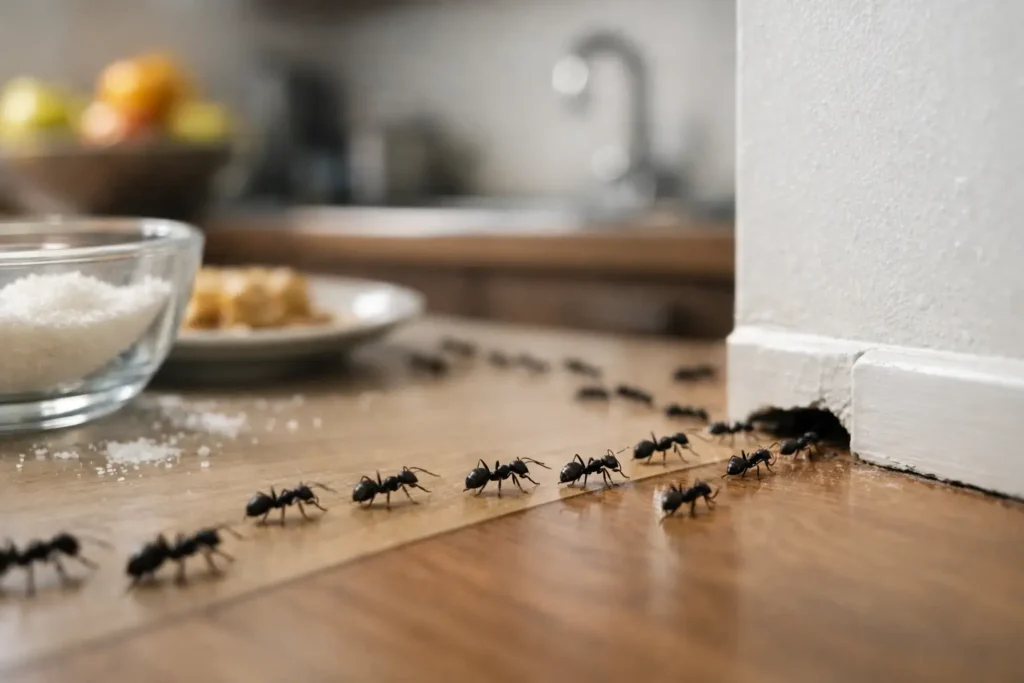
You wipe the counter. You spray the trail. For a day or two, nothing. Then they’re back — same spot, same line, like nothing happened. If that pattern sounds familiar, you’re not doing anything wrong. The ants you see are almost never the actual problem.
A single ant colony can hold thousands of workers, with a queen capable of laying hundreds of eggs a day. The ants marching across your kitchen are scouts and foragers — a small, expendable fraction of the colony sent out to find food and water. Killing them with contact spray feels productive, but it doesn’t touch the nest, and it definitely doesn’t touch the queen. In Los Angeles County and Orange County, where mild weather keeps colonies active most of the year, that gap between “looks handled” and “actually handled” is exactly why ants keep returning.
The Real Reason Ants Return: You’re Treating Symptoms, Not the Source
When a scout ant finds a reliable food or water source, it lays down a pheromone trail on the way back to the nest. Other workers follow that trail, reinforcing it every trip. That’s why a couple of ants near the sink can turn into a steady line along the baseboard within a day.
Store-bought contact sprays only kill the ants they physically touch. The colony — which may be inside a wall void, under a slab, beneath a patio, or in nearby landscaping — is untouched and keeps producing new foragers. Some ant species respond to spray exposure by “budding”: splitting the colony into multiple smaller nests as a survival response. That means aggressive DIY spraying can occasionally make an infestation more dispersed, not less.
Repellent sprays create a second problem: ants smart enough to detect and avoid a treated area will often just find a new route in — a different crack, a different window gap — days later. It can look like the ants are gone when they’ve actually just relocated their trail.
Also Check: How to Prepare for Fumigation: A Complete Checklist for Homes and Businesses
What’s Actually Attracting Ants to Your Property
Ants don’t need a messy house to find a reason to come in. Common attractants include:
- Crumbs under appliances, sticky cabinet shelves, pet food left out overnight, or recycling residue
- Moisture — leaky pipes under sinks, condensation around AC units, overwatered plants, wet sponges. During dry Southern California stretches, ants may move indoors specifically hunting for water.
- Dense vegetation, mulch, or stacked materials touching the exterior walls, which gives ants a protected bridge straight to the structure
- Small, easy-to-miss entry points around window frames, door thresholds, plumbing lines, and utility penetrations
Why Sprays Alone Rarely Solve the Problem — But Baits Can
Baits work on a completely different mechanism than sprays. Foraging ants carry bait back to the nest and share it with the rest of the colony, including the queen — which is the only way to actually reduce colony size rather than just the visible worker count.
But baiting only works if it’s done correctly:
- The wrong bait for the ant species won’t get carried back. Different ants prefer sweet, protein, or grease-based baits depending on their nutritional needs at the time.
- Never spray repellent products near bait stations. Repellents cause ants to avoid the area entirely, including the bait.
- Placement matters. Bait needs to sit along an active trail, not just anywhere convenient.
- Preferences shift seasonally. A bait that worked in spring may be less effective by late summer as colony needs change.
This is why inspection-driven professional ant control consistently outperforms DIY: identifying the species, tracking the trail back toward likely nesting areas, and matching the treatment method to what’s actually happening — rather than repeatedly treating whatever ants happen to be visible that day.
Also Check: Rodent Proofing Versus Trapping: Which One Actually Stops Rodents for Good?
How to Stop Ants From Coming Back — For Real
A lasting fix usually combines four things at once:
- Remove easy food and water sources. Wipe counters and dining areas immediately, store pantry food in sealed containers, fix drips and leaks, and don’t leave pet food out for extended periods.
- Address moisture specifically. If ants keep showing up near a bathroom or kitchen sink, moisture deserves as much attention as food — sometimes more.
- Manage the exterior. Trim vegetation away from the structure, keep mulch and stored materials off exterior walls, and check door sweeps and window screens.
- Seal entry points — but time it right. If an active colony already has an established indoor route, sealing every gap before treating the colony can just push activity to a new opening. A coordinated plan treats first, then seals.
When It’s Time to Call a Professional
Bring in a licensed pest control provider when trails return after DIY treatment, activity shows up in multiple rooms, you see ants near electrical outlets or wall cracks, or you’re managing a rental/commercial property where tenants or customers are affected. Persistent, repeat activity almost always points to a hidden nest, an ongoing moisture source, or multiple entry routes that are genuinely difficult to find without an inspection.
A professional plan typically includes strategically placed baits, non-repellent perimeter treatments, exterior work, nest treatment where accessible, and a follow-up visit to confirm the trail has actually stopped — not just gone quiet for a few days.
If the same ants keep coming back no matter how many times you clean and spray, the trail isn’t the problem — the colony behind it is. Impressive Exterminating provides inspection-based ant control across Los Angeles County and Orange County. Call (562) 246-9044 for a free inspection.
Frequently Asked Questions
Why do ants keep coming back even after I spray them myself?
Because contact sprays only kill the visible worker ants, not the colony or the queen producing new ones. As long as the nest is intact — whether it’s in a wall void, under a slab, or in outdoor landscaping — new foragers keep coming out to search for food, often along the exact same route.
Can spraying ants make the problem worse?
In some cases, yes. Certain ant species respond to spray disturbance by “budding” — splitting into multiple satellite colonies as a defensive response. This can turn one nest into several, making the infestation harder to fully resolve. Heavy spraying near an active trail can also disrupt foraging before ants carry bait back to the nest, which undermines baiting efforts.
How long does it take for professional ant treatment to actually work?
It varies by colony size, species, and treatment method, but noticeable reduction in activity often happens within a few days to a few weeks. Baiting specifically takes time because it relies on foragers carrying the product back to the nest — a fast kill isn’t the goal; colony elimination is.
Do I need to find the ant nest myself before calling an exterminator?
No. Locating the nest is part of what a professional inspection is for — technicians look at trail patterns, likely nesting conditions (moisture, wood damage, landscaping), and entry points to determine where the colony most likely is, even when it’s not visible.
Should I seal every crack and gap where I see ants entering?
Not immediately, if the colony is still active indoors. Sealing every entry point before the colony is treated can simply redirect ants to a different opening, making the problem seem to move rather than resolve. A coordinated approach treats the active colony first, then seals entry points once activity has stopped.
Why do ants seem to come back every spring in Southern California?
Southern California’s mild climate means many ant species stay active nearly year-round, but colonies often increase foraging activity and produce new reproductive members (swarmers) as temperatures rise in spring, which is when many homeowners notice a spike in visible activity — even if the colony was present all along.
Is it normal for ants to show up indoors after rain, even without a leak?
Yes. Outdoor ant nests can be flooded or disturbed by rain, prompting colonies to relocate temporarily — sometimes into a nearby structure. This is a common, seasonal pattern rather than a sign of a new indoor moisture problem, though it’s still worth checking for one.